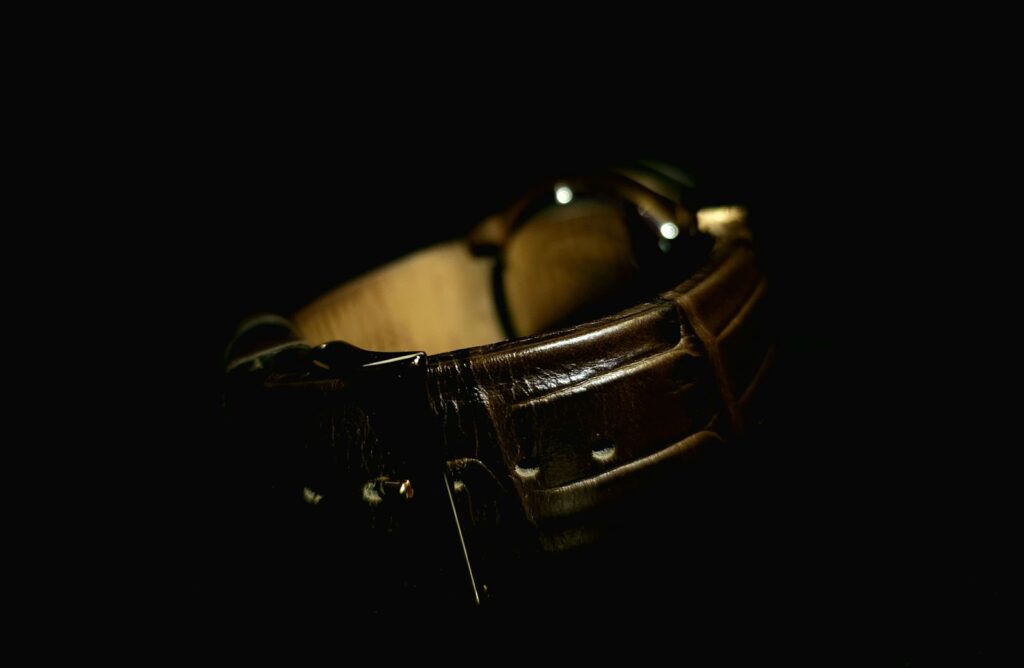
Honest sourcing note: “Alligator” and “crocodile” are different species — true alligator is American (Alligator mississippiensis); most Indonesian/Asian straps are saltwater crocodile (Crocodylus porosus), the same luxury tier. We label species accurately and never sell embossed calf as exotic. Genuine crocodilian is CITES-regulated (typically Appendix II, farmed); international orders ship with documentation, and you are responsible for your country’s import rules — this is general information, not legal advice. Prices are indicative ranges (mid-2026); final pricing is by quote. We are an independent authority and sourcing desk and connect you to vetted makers.
A 22mm alligator watch strap is a strap with a 22 mm lug width, typically used on sport and larger-diameter watches, cut from genuine American alligator (Alligator mississippiensis). At Alligator Watch Straps we build and source 22 mm straps with honest species labelling, precise 22 → 18 mm tapers, and thickness tuned for real-world fit on modern cases and deployant clasps.
What “22mm alligator watch strap” actually means
On this page, “22 mm” refers to the lug width – the distance between the inside faces of the lugs where the spring bar sits. A 22 mm strap is cut to this width at the case end, then usually tapers narrower toward the buckle for comfort and balance.
For most builds we recommend a 22 mm to 18 mm alligator strap (22 → 18 mm taper). That 4 mm taper is the modern sport standard: substantial at the case, but not bulky at the clasp. Straighter tapers (22 → 20 mm) are also possible for customers who prefer a more technical or integrated look.
Alligator Watch Straps is an independent specialist. We are not a tannery or a fashion brand. We run a sourcing and specification desk: we specify the exact species, pattern, cut, thickness and construction you want, and then we match that spec to vetted workshops and leather partners. No one can pay to change what we publish; if you proceed with our partner they may pay us a referral fee at no extra cost to you.
Species: real American alligator vs crocodile (porosus and others)
“Alligator” is often used loosely in strap marketing; we do not do that. On this site:
- Alligator means American alligator (Alligator mississippiensis), almost always farmed in the United States, tanned in Europe, the US, or Asia.
- Crocodile means one of the crocodylus species, most often saltwater crocodile (Crocodylus porosus) or Nile crocodile (Crocodylus niloticus) in high-end strap applications.
- Embossed calf is labelled as such. We never call stamped cowhide “alligator” or “crocodile”. If it’s bovine, we say so.
Many “alligator” straps sold out of Indonesia, Vietnam, Thailand or China are actually Crocodylus porosus (saltwater crocodile) or other crocodile species. That’s not a downgrade – porosus is the same luxury tier as alligator in bags and straps – but it is a different animal and must be labelled correctly for ethics, legality and CITES paperwork.
For this 22 mm page, we support three main exotic options:
- American alligator (A. mississippiensis)
- Classic luxury dress/sport strap material. Belly and tail skins with smooth, even tiles. Most Swiss “alligator” bracelets are this species.
- Saltwater crocodile (C. porosus)
- Often marketed incorrectly as alligator. Slightly different scale geometry and pore pattern. Common in Southeast Asian production.
- Calf embossed “alligator” grain
- Non-exotic cowhide with a pressed pattern. We list this only as calf; never as alligator or crocodile.
CITES, legality and what a responsible 22mm exotic watch band involves
Both genuine alligator and most crocodile species used in straps are covered by the CITES (Convention on International Trade in Endangered Species) framework. For watch straps that matters in three main ways:
- American alligator (A. mississippiensis) – generally listed on CITES Appendix II. Trade in farmed skins and products is common and regulated.
- Crocodylus porosus and C. niloticus – also typically Appendix II when from approved ranching/farming programs.
- Export / import – moving a finished strap across certain borders (especially as commercial shipments) may require CITES export permits and local import formalities.
Our role is to help you specify and source ethically and legally. We insist that upstream partners use legally farmed or ranch-harvested skins with correct CITES documentation at the time they are exported. We do not provide legal advice, and regulations vary by country and can change. Buyers must verify any import rules and paperwork requirements applicable to their own jurisdiction before placing commercial or bulk orders.
Dimensions that matter on a 22mm sports / large‑case strap
Beyond lug width, three measurements define how a 22 mm exotic strap will actually wear on the wrist:
- Taper – the width at the buckle end.
- Thickness profile – especially at the lugs and at the mid-strap padding hump.
- Length – tip-to-buckle fit around your wrist and clasp type.
Standard tapers: 22 → 18 vs 22 → 20
For most 22 mm sport and larger cases we recommend:
- 22 → 18 mm – our default “22 mm to 18 mm alligator strap” spec. Balanced and comfortable, compatible with many aftermarket 18 mm deployant clasps. Works visually on 40–45 mm watches.
- 22 → 20 mm – keeps more visual mass at the buckle end. Good for integrated clasps, big tool watches, or clients who prefer a heavier presence.
- 22 → 16 mm – occasionally requested for very tapered, dress‑leaning builds. Not typical for pure sports pieces, but we can spec it on request.
Padded vs flat: what suits a 22mm sports strap
For 22 mm widths, padded construction is far more common than flat, especially on chronographs and dive‑inspired cases.
- Padded 22 mm alligator strap: foam or leather insert between upper and lining, usually 4.0–5.0 mm thick at the lugs, tapering to 2.5–3.0 mm at the buckle. This fills the gap under tall cases and gives a more athletic stance.
- Flat 22 mm strap: uniform 2.2–3.0 mm thickness. Cleaner profile, useful for tight-fitting bracelets, vintage cases, or thin deployants.
On modern sports cases (e.g. 42 mm chronograph, 44 mm diver) we usually spec “moderate padding”: around 4.2–4.5 mm at the lugs so the strap has presence without feeling blocky. All thickness ranges are indicative and are set per build after we confirm case geometry and clasp type.
Length, holes and fit
“Standard” lengths for a 22 mm strap suit many wrists, but we still measure:
- Typical two‑piece length: keeper side ~115–120 mm, hole side ~75–80 mm, for wrists roughly 16–19 cm.
- Deployant‑specific lengths: often shorter on the hole side by 5–10 mm to centre the clasp under the wrist.
- Hole layout: most builds use 6–7 sizing holes at ~6–7 mm spacing, but this can be adjusted for small or large wrists.
If you want a custom 22 mm exotic watch band, we can work from your actual wrist and watch measurements rather than “standard”. That avoids the common problems of overlong tail ends on smaller wrists or tight last-hole fit on larger wrists.
Construction: how a high‑grade 22mm exotic strap is built
A 22 mm strap in alligator or crocodile can be overbuilt easily. Our job is to spec a construction that is robust enough for sports wear but not clumsy.
Upper leather: cuts and pattern orientation
On a 22 mm width the tile pattern becomes visually important:
- Belly cut alligator: larger, squarer tiles in the centre, smaller along the edge. Good for dress‑sport crossovers.
- Flank / side cut: more elongated tiles, tighter pattern. Works well for very sporty looks and smaller wrists.
- Tail cut: elongated, often with a distinctive taper in the tile size. Visually dynamic on wide straps.
We match cut and orientation to the watch style. A tool chronograph can tolerate a more dramatic pattern; a clean three‑hander on a 22 mm lug usually benefits from a calmer belly layout.
Lining leather: comfort and sweat resistance
Exotic on the inside is unnecessary bulk. For 22 mm sports builds we almost always use one of the following linings:
- Zermatt‑type calf: smooth, anti‑allergic, optimized for sweat resistance.
- Vegetable‑tanned calf: more “natural” feel, darkens with age.
- Rubber‑backed constructions: for customers who want maximum moisture tolerance while keeping an exotic upper.
Stitching, keepers and edge finishing
On wider straps, details are more visible:
- Stitching: machine or hand saddle‑stitched. Thread thickness typically 0.4–0.6 mm on 22 mm straps, chosen to match case style.
- Keepers: one fixed, one floating, usually in matching exotic. Width and thickness scaled so they actually control the tail on thick straps.
- Edges: painted and polished multiple times; optionally lightly beveled. Rembordé (wrapped) construction for additional water resistance is available on request.
Grading: how we describe skin quality on 22mm straps
Different tanneries and workshops use different letter grades (A, B, etc.). Those systems are not standardised. To avoid confusion we reference three practical levels for 22 mm exotic straps:
- Premium / “select” tiles
- Relatively uniform, clean tiles across the visible area; minimal scars or natural defects. What most luxury‑brand watch buyers expect.
- Collector / “first pick”
- Exceptionally consistent pattern, hand‑selected for symmetry on the pair of strap pieces. Typically drawn from the best portion of the belly.
- Character / “natural mark” skins
- Accepts some scars, healed scratches, or more irregular tiles. Structurally sound but visually more rugged; can suit tool watches well.
For most 22 mm sports builds we aim for premium/select. It keeps the watch looking high‑end without wasting material chasing absolute symmetry where it’s not needed.
Typical watches that use a 22mm lug width
Many contemporary watches in the 40–45 mm range use 22 mm lugs, especially sports, dive and pilot styles. Common patterns include:
- Modern divers and “desk divers”.
- 42–44 mm chronographs and racing watches.
- Pilot / aviation watches in the 41–44 mm range.
- Cushion‑case and tonneau sports models.
Some integrated‑bracelet watches also measure approximately 22 mm at the case interface but require proprietary end‑link or curved‑end designs. For these, we usually request clear photos and precise caliper readings before confirming if a custom 22 mm strap is feasible.
22mm crocodile strap vs 22mm alligator: practical differences
For most owners, both high‑grade alligator and porosus crocodile will wear similarly in terms of comfort and durability if tanned and constructed well. The main differences are about pattern, market tradition, and honest labelling.
| Feature | 22mm alligator strap (A. mississippiensis) | 22mm crocodile strap (C. porosus or similar) |
|---|---|---|
| Typical scale look | Squarer belly tiles, smooth transitions, fewer visible pores. | Slightly more elongated tiles; pores more visible near the centre of each scale. |
| Common origin | Farmed in the USA, tanned in US/EU/Asia. | Farmed/ranch‑harvested in Southeast Asia, Australia, Africa depending on species. |
| Market positioning | Classic Swiss “alligator” strap standard. | Equal‑tier luxury exotic, but often mislabelled as alligator in mass‑market listings. |
| Regulation | CITES Appendix II (farmed), widely traded with paperwork. | Also typically Appendix II from approved programs; paperwork still required for export. |
| Care & wear | Comparable; avoid full submersion and dry slowly after sweat exposure. | Comparable; quality of tanning and construction matters more than species. |
We will always specify exactly which species and approximate origin you are being quoted for. If you ask for “alligator” and the only viable offer available is porosus crocodile, we will say so explicitly and label it as a 22 mm crocodile strap, not alligator.
Price ranges, MOQs and lead times for 22mm exotic straps
Specific pricing varies by species, grade, construction complexity, order size and origin. The ranges below are indicative for properly finished, lined, stitched 22 mm straps, last verified June 2026:
- Single custom 22 mm American alligator strap: typically somewhere in the low‑hundreds to mid‑hundreds of USD equivalent, depending on grade, padding, stitching and lining choices.
- Single custom 22 mm crocodile strap: broadly similar ranges to alligator at comparable quality; some sources slightly lower, some slightly higher.
- Wholesale / OEM batches (exotic upper, calf lining): indicative OEM unit pricing in batches of a few dozen or more often falls into the high‑two‑digit to low‑hundreds USD equivalent per strap, scaled by quantity, grade and finishing level.
Minimum order quantities (MOQ) for custom logo or OEM work commonly start in the few‑dozen range per configuration, but some workshops will accept smaller runs at higher per‑unit cost. Lead times for made‑to‑order 22 mm exotic straps typically fall in the 4–10 week window depending on workshop load, shipping, and CITES paperwork for any cross‑border moves of unfinished components. Those timing ranges are also indicative and should be confirmed at the quoting stage.
For an accurate quote matched to your case, clasp and order size, plan your trip through our sourcing desk – you can share photos, lug and wrist measurements, and we can follow up by email or WhatsApp with options.
Custom 22mm alligator and crocodile strap ordering
Custom does not have to mean complicated. To spec a 22 mm strap properly we usually need:
- Watch details: brand/model if known, or clear photos of the watch head with the existing strap/bracelet removed, including a close‑up of the lugs.
- Measurements: lug width confirmed with calipers (22 mm nominal), case thickness at the lugs, and your wrist circumference.
- Use case: daily office wear, rotation piece, occasional sports, humid climate, etc. This influences padding, lining, and stitch choices.
- Species preference: American alligator vs 22 mm crocodile strap, or willingness to consider both depending on pattern and budget.
- Color & finish: black, dark brown, navy, tobacco, colored dyes, matte vs semi‑matte vs gloss.
From there, we translate those choices into a spec sheet that a workshop can quote precisely: 22 → 18 mm taper, 4.5 mm padded at lugs, 2.8 mm at buckle, belly cut, Zermatt‑type lining, stitch color and style, hole count, etc.
Will a 22mm strap fit a 21mm lug?
This is a frequent question, especially for customers with 21 mm lugs who want a 22 mm exotic strap because it’s more widely available.
- Forcing 22 mm into 21 mm lugs – we do not recommend it. Compressing leather by 1 mm on each side risks distorted edges, poor seating of the spring bar, and potential case damage.
- Proper 21 mm strap – the correct answer for a 21 mm lug is a 21 mm strap, even if that means going custom instead of off‑the‑shelf.
- Micro‑tolerances – a very small number of cases are cut slightly generous and may accept a strap nominally 0.5 mm wider, but this should never be assumed across brands or models.
If your watch is 21 mm and you like the look of our 22 mm alligator specifications, we can replicate the pattern and construction as a true 21 mm build so it fits safely.
How our sourcing desk helps collectors and brands
Alligator Watch Straps operates as an independent reference and sourcing point for exotic‑leather straps. We do not run our own tannery or strap factory. Instead, we:
- Maintain up‑to‑date technical notes on species, cutting patterns, tanning variations, and real‑world strap dimensions.
- Vet workshops for consistent construction quality, honest species labelling, and willingness to work to exact lug/taper/thickness specs.
- Help collectors articulate their needs in workshop language so that quotes and results match expectations.
- Assist micro‑brands, retailers and strap labels in building OEM 22 mm exotic programs (logo embossing, clasp sourcing, standardised SKUs) with correctly documented species.
If you move ahead with one of the makers we introduce, they may compensate us via a referral fee structure. That does not change the specs we advocate for. Our priority is accurate, durable, and honestly labelled exotic straps.
Start a 22mm alligator or crocodile strap project
If you need a 22 mm alligator watch strap or a correctly labelled 22 mm crocodile alternative for a sports or larger‑case watch, we can help you frame the right spec and connect you with a suitable maker or supplier.
Plan your trip through our contact page – outline your watch, your wrist, and how you intend to wear the strap. If you prefer real‑time back‑and‑forth, mention that you’d like to plan via WhatsApp and we’ll share the appropriate contact details during the quoting process.
FAQs: 22mm alligator and crocodile straps
Which watches commonly use a 22mm alligator watch strap?
Many modern divers, larger chronographs, pilot watches and cushion‑case sports models in the 40–45 mm range use 22 mm lugs. The exact spec varies by brand, but 22 mm is a common standard for contemporary sports and large‑case watches.
Should I choose a padded or flat 22mm exotic strap?
For a thicker sports watch, a padded 22 mm strap (around 4–5 mm at the lugs) usually looks and feels better, filling the gap under the case. For thinner or vintage‑style watches, or if you use a very low‑profile deployant clasp, a flatter 2.5–3 mm construction can be more appropriate.
Can I put a 22mm strap on a 21mm lug watch?
We do not recommend forcing a 22 mm strap into 21 mm lugs. It can distort the strap, stress the spring bars, and mark the case. A correctly sized 21 mm strap is the right solution, and we can spec one with the same construction details you like on a 22 mm build.
Is a 22mm crocodile strap lower quality than real alligator?
No. High‑grade porosus or comparable crocodile is the same “luxury tier” as American alligator. Quality depends more on the specific skin, tanning and construction than on species. The key point is honest labelling: if the strap is crocodile, it should be sold as crocodile, not alligator.
Can you supply wholesale 22mm alligator straps for my brand?
Yes. We can help define your 22 mm specs (species, cut, padding, tapers, lengths, lining, branding) and introduce you to vetted OEM strap makers. MOQ and pricing ranges depend on configuration and quantity. Contact us with your target volume and positioning to get indicative ranges and lead time estimates.