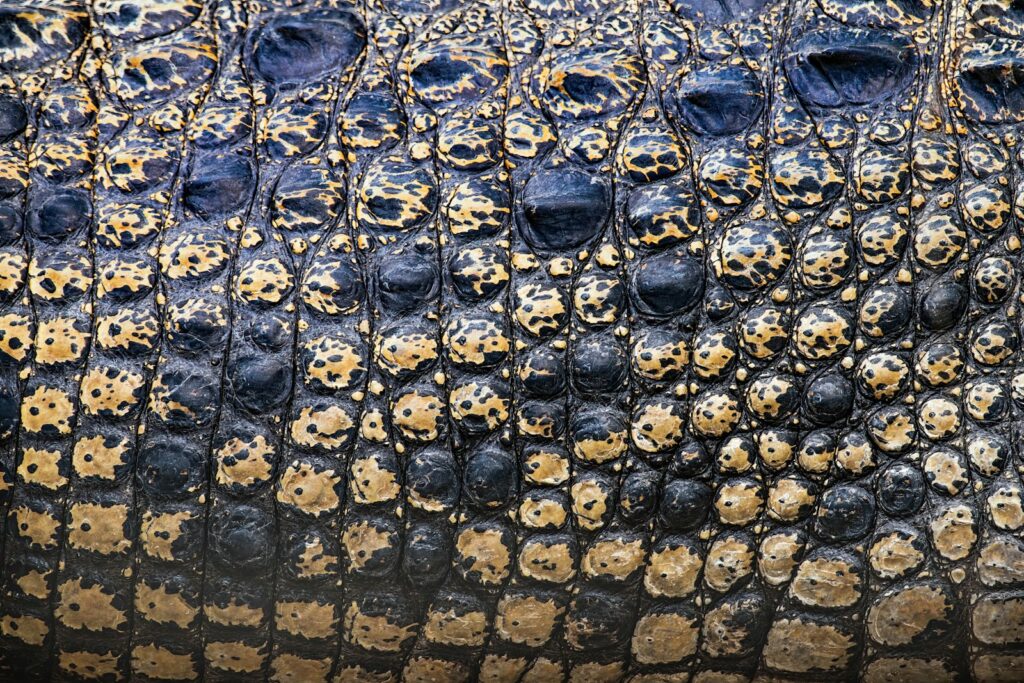
Honest sourcing note: “Alligator” and “crocodile” are different species — true alligator is American (Alligator mississippiensis); most Indonesian/Asian straps are saltwater crocodile (Crocodylus porosus), the same luxury tier. We label species accurately and never sell embossed calf as exotic. Genuine crocodilian is CITES-regulated (typically Appendix II, farmed); international orders ship with documentation, and you are responsible for your country’s import rules — this is general information, not legal advice. Prices are indicative ranges (mid-2026); final pricing is by quote. We are an independent authority and sourcing desk and connect you to vetted makers.
A crocodile watch strap is a watch band cut from genuine crocodilian hide, most often saltwater crocodile (Crocodylus porosus), tanned and built to precise watchmaking dimensions. On this page we explain exactly what that means — species, legality, cuts, grades, and how a real porosus crocodile watch strap compares to American alligator.
What is a crocodile watch strap, exactly?
A crocodile watch strap is a finished strap made from genuine crocodile leather, usually:
– **Saltwater crocodile (Crocodylus porosus)** – often shortened to “porosus”
– Less commonly Nile crocodile (Crocodylus niloticus) or other regional species
In the luxury strap market, **“crocodile” almost always means C. porosus**, the same species used for high-end bags and small leather goods from top luxury houses. Porosus is prized for:
– Tight, even scale pattern
– Small “pore” marks at the back of each scale
– A dense yet fine fiber structure that holds shape
At Alligator Watch Straps, we label every strap by **correct species**:
– **Alligator** = American alligator (*Alligator mississippiensis*)
– **Crocodile** = explicitly named species (most often *Crocodylus porosus*)
We do not call any **embossed calf** “alligator” or “crocodile,” even if the pattern is similar. If it is not a legally sourced crocodilian hide, it is not sold here as exotic.
Porosus: the saltwater crocodile behind true luxury straps
What “porosus” means
“Porosus” is short for **Crocodylus porosus**, the saltwater crocodile native to parts of Australia, Southeast Asia, and the Indo-Pacific. In the leather world, “porosus” has become a shorthand for the **top tier of crocodilian skin**:
– Very **fine, regular belly scales**
– Distinct tiny dots or pores at the back of each scale
– High fiber density, which gives both suppleness and longevity
That combination is why porosus is the main crocodile species used for **Hermès/LV-tier** leather goods (we’re talking species, not any particular tannery relationship).
Porosus belly vs hornback
Most porosus watch straps use **belly skin** rather than hornback. Each cut has a very different look and feel:
- Porosus belly
- Flat, even scales from the underside of the animal. This is the classic “dress” crocodile look: smooth, refined, ideal for formal and luxury watches.
- Porosus hornback
- Raised, armored scales from along the spine. Very three‑dimensional, more aggressive and casual. Popular for sports/diver watches or statement pieces.
For most **porosus watch strap** builds, we recommend:
– **Belly** for dress watches, thin cases, and classic looks
– **Hornback** for tool watches, dive watches, or if you want maximum texture
Why porosus is considered premium
Porosus tends to command higher material prices than many other crocodilian leathers because:
– **Scale pattern** – small, symmetrical, and visually “quiet”
– **Scarcity** – controlled farming and limited legal supply
– **Yield** – only a narrow section of each belly produces the best strap panels
That premium applies at the skin level. Once you add **cutting waste, lining, padding, edge finishing, and labor**, the difference between a very good alligator strap and a very good porosus strap is often **a modest step up in cost**, not a doubling.
We treat porosus as a **lateral luxury option** to American alligator, not a marketing excuse to overcharge.
Crocodile vs alligator: species, pores, and marketing myths
The species line: A. mississippiensis vs C. porosus
True alligator and true porosus crocodile are **different species**:
– **American alligator** – *Alligator mississippiensis*
– Primarily from the United States
– CITES Appendix II, farmed and wild‑harvested in regulated programs
– **Saltwater crocodile** – *Crocodylus porosus*
– Farmed mainly in parts of Australia and Southeast Asia
– CITES Appendix II, farmed under strict control
Both are **legally traded exotics under CITES** (more on that below). The key is honest labelling:
– If it’s *Alligator mississippiensis*, call it **alligator**.
– If it’s *Crocodylus porosus*, call it **crocodile** or **porosus**.
– Never blur the line for marketing.
How to tell crocodile from alligator on a strap
On a finished **crocodile leather watch band**, the quickest visual tells are:
– **Pores / dots**
– Porosus: tiny, consistent dots at the back of individual scales.
– Alligator: pores may be less visible or arranged differently; overall “cleaner” look.
– **Scale shape**
– Porosus: belly scales often slightly more rectangular and regular.
– Alligator: can show more variation; flanks and tails introduce asymmetry.
– **Transition zones**
– On a large leather panel, the transition from belly to flank/tail differs by species; on a 20 mm strap you often only see a small window.
On a narrow strap section, it can be difficult even for experienced collectors to be 100% sure. That is exactly why **documentation and honest declarations from the maker matter more than “eyeballing” or guessing**.
Why many “alligator” straps are really porosus
In parts of Indonesia and Asia, you will see straps advertised as:
– “Genuine Alligator – Asian farmed”
– “Local Gator – premium”
– “Indonesia Alligator Belly”
In most of these cases the hide is actually **saltwater crocodile (C. porosus)** or another crocodile species, not American alligator. Porosus is an excellent, high‑tier leather — comparable in class to alligator — but it is still **incorrect to label it “alligator.”**
Our policy:
– If the hide is *Alligator mississippiensis*: labelled **Alligator**.
– If the hide is *Crocodylus porosus*: labelled **Porosus crocodile** or **Saltwater crocodile**.
– If the hide is another crocodilian: species stated where documented.
– If species cannot be documented to a standard we accept: we do **not** present it as exotic.
We will never sell a porosus watch strap as “alligator” to ride on American alligator’s name recognition, nor will we “upgrade” calf to exotic through embossing.
Belly vs hornback crocodile straps: fit, feel, and aesthetics
Belly cut porosus straps
Belly‑cut porosus straps are the **classic luxury crocodile** choice:
– **Surface** – flat, low‑texture scales; smooth under a cuff
– **Dress use** – pairs well with Calatrava‑style dress watches, slim Omegas, white‑metal cases
– **Wear comfort** – less bulk, easier break‑in than hornback
We use belly for most of the following spec ranges (depending on the case):
– **Widths**: 18, 19, 20, 21, 22 mm at the lugs as standard; other widths by custom order
– **Tapers**: typically 18→16 mm, 20→16 mm, 21→18 mm, 22→18 mm; we can cut more aggressive or straight tapers on request
– **Thickness**: about 2.6–3.5 mm at the lugs for dress builds, stepping down toward the tip
Hornback porosus straps
Hornback porosus straps are **visually stronger and more three‑dimensional**:
– **Raised scutes** from the back/spine give a rugged texture
– Great match for **divers, pilot watches, chronographs, or large sports pieces**
– Slightly stiffer at first; break‑in is longer but result can feel very secure
Because hornback adds height, we typically:
– Keep **overall thickness around 3.5–4.0 mm** at the lugs
– Recommend **wider widths (20–24 mm)** so the case doesn’t overpower the scales
– Advise against hornback for very thin or very small cases
Build specs: widths, tapers, keepers, and hardware
Standard sizing ranges
For ready‑to‑wear and most custom work, we work within the following **indicative spec ranges** (dimensions in mm, all measured with calipers, not approximated):
– **Lug widths**: 16 / 17 / 18 / 19 / 20 / 21 / 22 / 23 / 24
– **Buckle widths** (tapers): 14 / 16 / 18 / 20 (straight and custom tapers on request)
– **Length pairs** (tip + buckle side, without buckle):
– Short: ~105 / 65
– Regular: ~115 / 75
– Long: ~125 / 80 – 85
Fully custom lengths available for small or very large wrists.
– **Thickness**:
– Dress porosus: ~2.4–3.2 mm at lugs, slight taper
– Sport / hornback: ~3.0–4.0 mm depending on case
Construction options
Typical build choices for a **saltwater crocodile strap** with us include:
– **Cut**: belly / hornback / tail where suitable
– **Padding**: flat, light, or moderate padded profile
– **Lining**:
– Calf (standard)
– Zermatt‑type leathers for higher sweat resistance
– Other hypoallergenic options by request
– **Edges**:
– Painted (multiple coats, sanded between layers)
– Turned edge (porosus folded over lining) on some patterns and thicknesses
– **Stitching**:
– Machine or hand‑stitched
– Matching or contrast thread
– “Saddle” hand stitch for high‑end custom
– **Hardware**:
– Standard tang buckles in steel or common case colors
– Compatible profiles for many OEM deployants (exact fit verified to spec, not guessed)
Every spec is defined in **actual numbers**, not “slim,” “regular,” or “extra padded” marketing language.
Grades: what “premium” porosus actually means
Visual grading of porosus skins
Crocodilian tanneries grade skins by visual and structural quality. Exact grading systems vary, but in practice for **strap‑grade porosus** you can think of:
– **Top cosmetic grade** – clean belly, minimal or no scars, even dye uptake
– **Mid grade** – small scars, growth marks, or pattern irregularities that can be worked around at strap scale
– **Utility grade** – more visible defects; better for small goods where flaws can be avoided or hidden
Our strap makers typically source **strap panels cut from top and mid‑grade bellies**. On your finished porosus strap, you should expect:
– **Natural variation** in scale shape and micro‑marks
– No **deep scars** across the primary visible area (unless you specifically request a “character” panel)
Price impact of grade
Because straps use **narrow strips**, a premium‑grade strap doesn’t use an entire hide the way a bag does. You pay more for:
– Better‑looking pools of scales
– Less risk of visible scars or thin areas
– More consistent color and finish
In practice, the gap between a very good mid‑grade and a cosmetic top‑grade porosus strap is noticeable to trained eyes, subtle on‑wrist. We’ll always specify:
– **The grade range used for your build**, and
– **Why** you might move up or down a step (e.g., budget vs absolute cosmetic perfection)
CITES, legality, and what “Appendix II” really means
CITES status of porosus straps
Both **American alligator** and **saltwater crocodile (C. porosus)** are listed under **CITES Appendix II**. In practice, that means:
– Trade is **allowed**, but **regulated**
– Animals are primarily **farmed or harvested** under national management plans
– **Skins and finished goods** crossing borders may require proper CITES permits and documentation
Most porosus leather in the strap market is **farmed**, not wild. That should be documented by the tanneries and wholesalers supplying the hides.
What this means for you as a buyer
If you’re buying or importing a **porosus watch strap**:
– **Domestic purchase** in many countries is straightforward if the strap was already imported with correct documentation.
– **International shipping** (seller in one country, you in another) may trigger CITES export/import paperwork.
We are **not** a law firm and cannot give legal advice. Regulations vary by:
– Your **country or state**
– Whether the strap is shipped alone or mounted on a watch
– The **declared value** and HS code used
We urge you to:
– Check your **local regulations** or speak with your customs authority
– Confirm that any export/importer in the chain is following CITES rules
– Keep invoices and documentation indicating **species and origin**
Our sourcing desk only works with suppliers who can provide **clear species labelling** and who understand CITES documentation for their markets, but final compliance is always the buyer’s responsibility.
Comparison: porosus crocodile vs American alligator straps
| Aspect | Porosus crocodile strap | American alligator strap |
|---|---|---|
| Species | Crocodylus porosus (saltwater crocodile) | Alligator mississippiensis (American alligator) |
| Typical origin | Farmed in Australia & Southeast Asia | Farmed & harvested in the United States |
| CITES listing | Appendix II (farmed, regulated trade) | Appendix II (managed trade) |
| Scale look | Very regular belly scales, small pores/dots | Slightly more variation, often smoother overall look |
| Common cuts | Belly and hornback for straps | Mostly belly & flank for straps |
| Applications | High luxury, strong pattern, hornback sport builds | Luxury dress and everyday high‑end straps |
| Durability | Excellent, dense fiber structure | Excellent, very stable and proven over decades |
| Price tier* | Upper tier exotic, often a step above calf & many gators | Upper tier exotic, similar overall to porosus |
*Relative only. Actual strap prices depend on maker, finishing, and order size.
Our editorial stance: **choose by look and fit first, species second.** Both are legitimate, long‑lasting exotic options as long as the labelling and paperwork are honest.
Price ranges, MOQs, and lead times (indicative)
We do not publish single fixed prices because:
– Exotic leather costs fluctuate
– Order size, spec, and maker all affect final pricing
– Some projects are fully custom, some semi‑custom, some wholesale
Based on our sourcing desk checks **last verified June 2026**, typical **porosus strap** pricing looks roughly like this:
Single and small‑batch custom porosus straps
Indicative ranges for **one‑off or small‑batch** builds via vetted independent strap makers:
– **Handmade custom porosus belly strap** (2–3 pieces):
– Approx. **USD 180–350 per strap** depending on:
– Grade of porosus panel used
– Edge finishing and hand‑stitch level
– Hardware choice and lining
– **Handmade porosus hornback strap**:
– Approx. **USD 220–400 per strap** due to cutting loss and more demanding construction
These are typical ranges; specific quotes can fall slightly below or above depending on your spec and the maker’s country and overheads.
Wholesale and OEM porosus strap orders
For brands, retailers, and OEM‑style runs:
– **Indicative MOQs** (Minimum Order Quantities) we commonly see:
– Around **30–50 straps per color/size combination** as a starting point
– Some factories will go lower for premium exotics at a higher unit cost
– **Indicative bulk pricing ranges** (porosus belly, stitched, lined, no buckle, mid‑2026 levels):
– Roughly **USD 65–150 per strap ex‑factory**, driven by:
– Volume (100+ vs 500+ units)
– Cut (belly vs hornback)
– Complexity (padding, edge style, stitching)
– Currency and freight at time of order
For specific **RFQs or wholesale enquiry**, contact our sourcing desk via plan your trip — we use WhatsApp heavily for spec clarification, samples, and progress photos if you prefer that channel.
Our role: independent authority, honest labelling, curated makers
We are **not** a tannery and we do not own crocodile or alligator farms. Alligator Watch Straps operates as:
– An **independent editorial authority** on crocodilian and exotic watch straps
– A **sourcing desk** that connects collectors, brands, and retailers with vetted strap makers and suppliers
Our commitments:
– **Correct species labelling** – Alligator = *A. mississippiensis*, Porosus = *C. porosus*, not “Asian alligator” unless it truly is.
– **No fake exotics** – Embossed calf remains calf in our copy, even if it is a practical alternative.
– **Real measurements** – Widths, tapers, and thickness given as actual numbers, not just “standard” or “premium.”
– **Transparent construction details** – Lining, padding, edge type, stitching, and hardware described clearly.
No one can pay to change what we publish; if you proceed with our partner they may pay us a referral fee at no extra cost to you. Our credibility with collectors and brands rests on **getting the facts right**, not on pushing any specific supplier.
Is a crocodile strap right for your watch?
Luxury dress watches
A **porosus belly strap** is a natural match for:
– Gold dress watches from major Swiss and German brands
– Slim white‑metal pieces where you want texture but not bulk
– Complication watches where the strap should be refined, not loud
Think 18–20 mm lug width, 2.6–3.0 mm thickness, gentle taper, hand‑finished edges.
High‑end sports and divers
For larger steel or titanium sports watches:
– Porosus hornback can highlight the case’s tool character
– Belly porosus with slightly more padding delivers dress‑sport versatility
– Wider lugs (20–24 mm) help scale the texture correctly
We do not recommend very thick hornback on ultra‑slim or vintage‑thin watches; proportion matters more than chasing visual drama.
Daily wear and longevity considerations
Porosus and alligator straps are **durable**, but not indestructible. Practical advice:
– Rotate straps if you live in a hot, humid climate
– Use a proper deployment clasp if you want to minimize bending stress
– Avoid soaking; occasional light moisture is fine, immersion is not
– Wipe down after heavy sweat and let dry away from direct heat
With reasonable care, a well‑made crocodile strap can serve as **a long‑term companion to your watch**, not a disposable accessory.
How we help with your porosus strap project
If you are:
– A collector seeking **one perfect porosus watch strap**
– A microbrand wanting **OEM‑level exotic straps** for your next release
– A retailer planning a **small curated run** of crocodile leather watch bands
We can help you by:
– Translating your aesthetic brief into **clear strap specs** (species, cut, widths/tapers, thickness, lining, stitch, hardware)
– Matching those specs to **vetted makers** at the right level (artisan, semi‑industrial, or full OEM)
– Flagging **CITES and logistics considerations** early so you can plan your markets and shipping routes
Start with a short summary of your watch, lug size, and how you plan to wear the strap, and we can build a spec sheet from there. Use plan your trip to share details — if you prefer, we can continue the conversation and share photos and drawings via WhatsApp.
FAQs: crocodile watch straps, porosus, and legality
What is a crocodile watch strap?
A crocodile watch strap is a watch band made from genuine crocodilian leather, most commonly saltwater crocodile (Crocodylus porosus). The hide is tanned, cut, lined, stitched, and finished to precise dimensions for watch use, typically in widths from 16–24 mm with various tapers and thicknesses.
How is a porosus watch strap different from an alligator strap?
A porosus watch strap uses saltwater crocodile (Crocodylus porosus), while an alligator strap uses American alligator (Alligator mississippiensis). Porosus typically shows very regular belly scales with small pores or dots on each scale and is often associated with high luxury goods. Alligator has its own distinct scale pattern and is equally legitimate as a top-tier exotic; the choice is mostly about the look you prefer and honest species labelling.
Is a crocodile strap good for luxury watches?
Yes. Both porosus crocodile and American alligator are traditional materials for luxury straps. A well-built porosus belly strap in the correct thickness and taper is fully appropriate for high-end dress and complication watches. Hornback porosus works well for larger sports or tool watches where a more aggressive texture suits the case design.
Are crocodile watch straps legal?
Porosus crocodile and American alligator are listed under CITES Appendix II, which allows regulated trade in farmed and managed populations. Legality for a finished strap depends on correct sourcing, permits, and your country’s import rules. We are not legal counsel; you should verify your local regulations and ensure any seller handles CITES documentation properly for international shipments.
How can I get a custom saltwater crocodile strap made to my specs?
Prepare your watch’s lug width, desired taper, target thickness, wrist size, and a few reference photos of finishes you like. Then contact our sourcing desk via plan your trip. We can refine your spec sheet, recommend belly or hornback cuts, discuss grades and lining options, and connect you with vetted makers. If convenient, we can handle ongoing coordination and photo updates via WhatsApp.