Honest sourcing note: “Alligator” and “crocodile” are different species — true alligator is American (Alligator mississippiensis); most Indonesian/Asian straps are saltwater crocodile (Crocodylus porosus), the same luxury tier. We label species accurately and never sell embossed calf as exotic. Genuine crocodilian is CITES-regulated (typically Appendix II, farmed); international orders ship with documentation, and you are responsible for your country’s import rules — this is general information, not legal advice. Prices are indicative ranges (mid-2026); final pricing is by quote. We are an independent authority and sourcing desk and connect you to vetted makers.
A genuine alligator watch strap is made from the skin of the American alligator (Alligator mississippiensis), not from crocodile and not from embossed calf. In practice, a real alligator watch strap has specific scale patterns, construction details, and paperwork that you can learn to recognize in minutes.
What “Genuine Alligator” Actually Means
Most listings say “genuine alligator strap” as if that settles it. It doesn’t. Three different things get mixed together:
- True American alligator (Alligator mississippiensis)
- Saltwater crocodile (Crocodylus porosus) and other crocodilians
- Embossed calfskin imitating an “exotic” texture
Only the first is correctly called alligator. The second is also a high-end exotic, but it is crocodile, not alligator. The third is just printed cowhide.
An authentic alligator strap seller should clearly state:
- The species (e.g. “American alligator, Alligator mississippiensis”)
- The cut (e.g. “belly” vs “hornback”)
- The finish (e.g. “matte” or “gloss”)
- The construction (e.g. “fully remborded, hand‑stitched”)
If you see only “alligator-style” or “gator pattern” and nothing else, assume embossed leather until the details prove otherwise.
Alligator vs Embossed Leather: The Practical Checklist
The fastest way to tell a genuine alligator watch strap from embossed calf is to look for repetition, edges, and the back side.
1. Perfectly Repeating Pattern = Embossed Calf
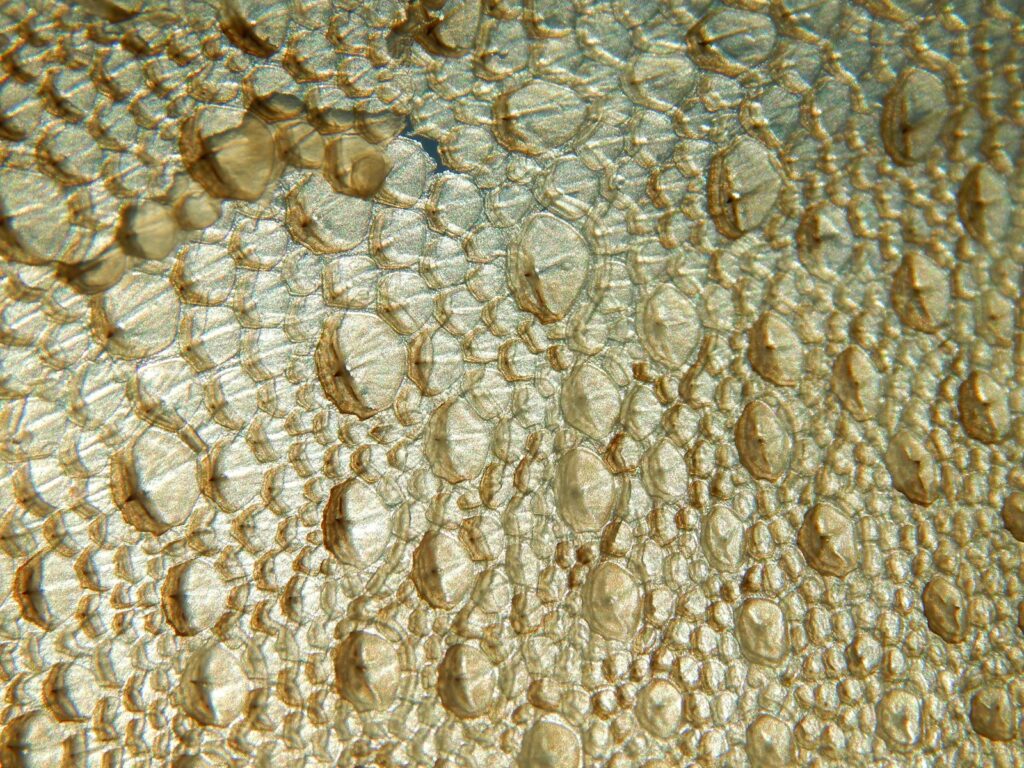
Real alligator hides are organic. The tiles (scales) change gradually across the skin:
- Near the belly: squarer, flatter tiles
- Toward the flanks: more irregular, rounded tiles
- Near the tail: smaller, narrower tiles
On a real strap, each tile is slightly different from its neighbour in shape and depth. No two straps look identical tile‑by‑tile.
On embossed calf (often described as “croc print” or “alligator-style”), a metal plate is pressed into the leather. The result:
- Pattern repeats in a predictable grid
- The same tile “clusters” appear multiple times on the same strap
- Bends and curves don’t distort the pattern the way a natural hide does
If you can line up two straps and the “scales” match exactly like wallpaper, you’re looking at print, not an authentic alligator strap.
2. Edges and Cut: Do the Tiles Get “Cut Off” Naturally?
Real exotic skins are cut around the watch strap pattern. That often means:
- Tiles at the very edge are cut at awkward angles
- You may see “half tiles” disappearing under the edge paint
- On tapered straps, the tile size changes as the strap narrows
Embossed patterns are often laid out to make the strap look “neat.” The tile layout stays surprisingly consistent from lug end to tip, with fewer half‑tiles or irregular cuts. It looks tidy in photos but unnatural if you know what real alligator does under the knife.
3. Look at the Back: Lining and Construction
A genuine alligator strap is almost always lined with a different leather, typically:
- Calfskin (often Zermatt, suede, or another sweat‑resistant lining)
- Occasionally rubber or a rubber‑calf composite for sports use
The back should state something like “Genuine Alligator,” “Alligator mississippiensis,” or simply “Alligator,” often with the size (e.g. 20/16) and maker’s mark. High‑end makers will avoid vague, incorrect terms like “Genuine Croco” if the leather is actually alligator.
Embossed calf is sometimes stamped “Genuine Leather,” sometimes “Croc Print,” sometimes nothing at all. If a strap claims to be alligator but the only stamp you see is “Genuine Leather,” ask for clarification.
4. Feel and Flex: How the Leather Behaves
Real exotic leather behaves differently in the hand:
- Alligator belly (matte): smooth to the touch, soft but “dense,” bends without sharp creasing if properly tanned.
- Alligator gloss: slick, with a clear finish over the tiles; feels like polished leather, not plastic.
- Embossed calf: often feels uniformly soft and “spongy,” with the pattern flattening quickly at bends.
Press your thumb into the tiles:
- On genuine alligator, you feel the difference between tile and the softer “valleys” in between.
- On embossed calf, the relief is shallower and more uniform; the texture can feel almost foamy.
5. Smell: Tanned Leather vs Plastic Finish
Smell is not conclusive, but it’s another data point:
- Quality alligator still smells like leather — even with gloss, there’s that distinct tanned scent.
- Cheap embossed straps can smell more like synthetic finish than leather, especially out of the box.
Smell alone won’t tell you alligator vs calf, but a strong chemical odour is a warning sign of low‑grade material and finish.
The Umbilical “Butterfly” and Other Alligator Markers
One of the most distinctive features of American alligator belly is the umbilical scar, sometimes called the “umbilical butterfly” or “navel mark.”
The Umbilical Scar
On a full belly skin, you’ll see:
- A small, roughly butterfly‑shaped area where the scale layout breaks pattern
- It’s usually slightly off‑center, surrounded by more regular belly tiles
- It can appear as crumpled, radiating, or irregular tiles
On straps, you might see just a fragment of this pattern, especially on wider widths (22–24 mm) cut near the center of the hide. It’s a nice confirmation of authenticity, but the absence of a clear “butterfly” on a narrow or carefully positioned strap doesn’t mean it isn’t alligator.
Alligator Tiles: Clean vs Pored Surfaces
Compared to most crocodile species, alligator tiles:
- Have a cleaner, more porcelain‑like surface on the belly
- Show fewer visible pin‑prick pores on each tile
- Transition more gently from square belly scales to more rounded flank scales
This “clean tile” appearance is one of the reasons high‑end watch brands favor alligator for dress straps.
Alligator vs Crocodile vs Embossed: Side‑by‑Side
- Species / Material
-
American alligator (Alligator mississippiensis): True “genuine alligator watch strap” material.
Saltwater crocodile (Crocodylus porosus): Top‑tier crocodile, similar price band, but a different species.
Embossed calf: Cowhide pressed with a croc/alligator pattern. - Tile surface
-
Alligator: Smooth, clean tiles; minimal visible pores.
Porosus croc: Fine pin‑prick pores near the front edge of many tiles.
Embossed calf: Patterned, but the “pores” are usually just shallow impressions. - Pattern regularity
-
Alligator & croc: Natural irregularity; tiles change size and shape across the strap.
Embossed: Regular, repeating pattern; identical sections appear more than once. - Labelling (honest)
-
Alligator strap: “American alligator,” “Alligator mississippiensis,” or “Alligator.”
Crocodile strap: “Crocodylus porosus,” “Saltwater crocodile,” or simply “Crocodile.”
Embossed calf: “Embossed leather,” “Croc print calf,” “Alligator‑style leather.” - Legal / CITES status
-
Alligator & most crocodile: CITES Appendix II, farmed and regulated; export typically needs CITES paperwork.
Embossed calf: Not CITES‑listed; treated as conventional bovine leather. - Price band (indicative, last verified June 2026)
-
Alligator & porosus croc: Commonly ~US$160–350 retail for a well‑made strap; custom and branded straps often higher.
Embossed calf: Often ~US$20–90 retail depending on brand and construction.
Species Honesty: Alligator vs Porosus (and Why It Matters)
In the market, “genuine alligator strap” is frequently used as a loose marketing term for any high‑end exotic with a rectangular tile. That’s not accurate.
True Alligator: American Alligator (Alligator mississippiensis)
If a strap is labelled “genuine alligator” in the strict sense, the hide should come from the American alligator. These are:
- Farmed under strict regulation in the United States
- CITES Appendix II listed — trade is allowed subject to quotas and documentation
- Widely used for high‑grade watch straps, small leather goods, footwear
The look: broad, flat belly tiles, clean and refined. For classic dress watches (think 18/16 or 20/16 mm, matte or semi‑matte), alligator belly remains the reference.
Saltwater Crocodile (Crocodylus porosus) Sold as “Alligator”
A large fraction of “alligator” straps produced in parts of Asia (especially Indonesia and elsewhere in Southeast Asia) are actually:
- Crocodylus porosus — saltwater crocodile, often shortened to “porosus”
- Sometimes other crocodile species, tanned and finished very similarly to alligator
Important points:
- Luxury tier: Porosus is at least as prestigious as alligator in fashion and leathercraft; sometimes more expensive at the raw skin level.
- Different species: Correct labelling should say “crocodile” or “saltwater crocodile,” not “alligator.”
- Look: Slightly narrower belly tiles, very fine pores at the front edge of each tile, giving a different character up close.
Alligator Watch Straps’ editorial policy is simple: we prefer precise names over marketing spin. Alligator is alligator. Porosus is crocodile. Both are top‑tier exotics, but they should not be conflated.
Embossed Calf: Not Exotic at All
Embossed calf is cowhide, sometimes decent quality, sometimes very low‑end. It is not an “exotic leather” in any regulatory sense. Ethical, legal, and CITES discussions that apply to gator/croc simply do not apply here; it’s sold under the same frameworks as ordinary leather goods.
A seller should never call an embossed strap an “authentic alligator strap,” and ideally shouldn’t use “alligator” at all beyond a clear description like “alligator‑pattern embossed calf.”
Real Alligator Watch Strap Construction: What to Expect
Once you’ve confirmed you’re looking at genuine alligator leather, the next level is construction quality. How the strap is built determines how long that exotic hide will last on your wrist.
Common Widths, Tapers, and Cuts
Most high‑end alligator straps follow certain dimensions:
- Lug widths: Typically 18, 19, 20, 21, 22 mm for modern watches; larger for big sports pieces.
- Tapers: Common tapers are 18/16, 19/16, 20/16, 21/18, 22/18 (lug/buckle in mm).
- Cuts: Belly cut (flat, rectangular tiles) or hornback (raised ridges from the back of the animal).
Belly cut alligator is the classic choice for dress straps. Hornback is more aggressive and niche, often used on wide straps for large cases.
How a Quality Alligator Strap Is Built
A well‑made strap should have:
- Remborded or turned edges: The alligator leather is wrapped over the padding and lining, then stitched, protecting the edge from sweat and fraying.
- Reinforced holes: Extra stitching or carefully compacted leather around the buckle holes to resist tearing.
- Consistent edge paint: Multiple coats, sanded between applications, with no bubbles or cracks out of the box.
- Even stitching: Tight, consistent thread spacing, with threads slightly recessed from the surface.
These details matter more for longevity than almost anything else. A poor build can destroy a good skin in a year; a good build can keep the same strap presentable for many years of regular wear.
Legal and CITES Context: Alligator and Crocodile Straps
Alligator and most crocodile species used for leather are listed on CITES Appendix II. That means:
- International trade is allowed but controlled through permits, quotas, and documentation.
- Commercial skins typically come from farms and ranches operating under wildlife management programs.
- Export of finished straps can require CITES re‑export permits depending on country and species.
Key points for buyers:
- Retail purchase within your country: Often straightforward; reputable sellers will have already dealt with import rules.
- Cross‑border shipping: Different countries have different enforcement practices, especially for personal imports of exotic leather goods.
- Travel: Some border officials may question high‑end exotic items; documentation from the seller can help.
This page is not legal advice. Regulations change, and enforcement standards differ by jurisdiction. If you’re commissioning or moving multiple exotic‑leather straps across borders, verify up‑to‑date requirements with your local authorities or customs broker.
Can You Trust Stamps and Certificates?
“Genuine Alligator” Stamps
A stamp that reads “Genuine Alligator” is useful but not absolute proof. It tells you what the maker is claiming, not necessarily what the leather is. Some low‑quality suppliers stamp embossed calf with misleading wording.
Treat stamps as one part of your evaluation, alongside:
- Pattern analysis (repetition vs natural variation)
- Scale structure (pores, tile boundaries, umbilical/irregular areas)
- Price band — very low prices and “alligator” rarely go together
- Seller transparency about species and origin
CITES Permits and Tannery Certificates
At the wholesale and manufacturing level, CITES permits and tannery certificates follow the hides, not each finished strap. By the time a strap hits retail:
- The seller may or may not provide copies of any upstream documents.
- Some high‑end brands issue their own authenticity cards or references to internal batch tracking.
Certificates are helpful, but again, they’re not the only thing that matters. A credible strap seller should have consistent species labelling across their product line, pricing that matches the material, and a clear story about where they source and how they build.
Mid‑way note: if you’re evaluating straps for a collection, custom build, or wholesale line and want a second set of eyes on species, quality, and CITES exposure, you can plan your trip with our sourcing desk over email or WhatsApp — we review designs, share indicative price ranges, and connect you with vetted makers.
Price Ranges and What They Tell You
Pricing is not proof of authenticity, but it’s a powerful filter. The raw material cost of a good alligator or porosus hide is high enough that below a certain price, true exotic is improbable.
Indicative retail ranges for single‑piece purchases (last verified June 2026):
- Embossed calf: Roughly US$20–90 depending on brand markup, stitching, and hardware.
- Entry‑level “genuine alligator” or crocodile: Typically around US$120–200 for factory‑made straps with machine stitching and standard lining.
- Mid‑ to high‑grade alligator / porosus croc: Commonly in the US$160–350 range for quality craftsmanship, hand‑finishing, and good hides.
- Top‑end, brand‑label exotics or full bespoke: Often US$300–800+ depending on watch brand, strap maker, and level of customization.
If you see a “genuine alligator watch strap” new for US$40 including shipping, assume it is embossed leather unless the seller can convincingly prove otherwise.
Natural Irregularity: Your Best Friend
The single best piece of advice for spotting a real alligator watch strap: embrace imperfections.
- Tile variation: Real skins have slightly crooked tiles, uneven valley depths, and small asymmetries.
- Color variation: Hand‑dyed or aniline‑finished exotics may show subtle darker edges around tiles or light tonal shifts across the strap.
- Hornback quirks: Raised ridges are inherently irregular, with slight shifts in height and separation.
Machine‑embossed straps err toward uniformity. Everything looks a bit too perfect and repeatable.
How Sellers Should Label Exotic Straps (and How You Can Hold Them To It)
As a buyer, you’re entitled to straightforward, technically accurate information. A responsible seller should be prepared to list:
- Species: “American alligator (Alligator mississippiensis)” or “Saltwater crocodile (Crocodylus porosus)” instead of generic “gator.”
- Material origin: At least the tanning region (e.g. European tannery, Asian tannery) if not the specific tannery.
- Construction: Remborded vs cut edge, stitched vs glued, padding type.
- Dimensions: Exact lug width and buckle width in millimetres; length in mm (e.g. 115/75).
- Lining: Calf, rubber, or other; hypoallergenic if applicable.
Questions you can ask any seller of an “authentic alligator strap”:
- Is this American alligator or crocodile (e.g. porosus)?
- Is the pattern printed/embossed or real exotic leather?
- What species name appears on your sourcing documents?
- What is the lining leather?
If they cannot answer these cleanly, consider shopping elsewhere.
Alligator vs Embossed Leather in Daily Wear
Beyond authenticity, there’s the practical side: how each material behaves on the wrist over years.
Durability
- Alligator / crocodile: Very strong for their thickness. The tiles act as micro‑armor, and a good belly cut can handle daily wear if lined properly and cared for.
- Embossed calf: Durability depends on the underlying calf and finish. Many crack at the creases after a year or two of hard use, especially if the embossing is deep and the leather is dry.
Aging and Patina
- Matte alligator: Develops a gentle patina, soft sheen, and softened tile edges with regular wear and conditioning.
- Gloss alligator: Finish can micro‑scratch over time; with gentle care, it maintains a dressy look for years.
- Embossed calf: Once the surface film cracks or wears, the pattern softens or disappears and can look fatigued quickly.
Care Requirements (Short Version)
- Avoid soaking any leather strap; remove it for swimming or heavy sports.
- Let a wet strap dry slowly in room air, away from direct heat or sun.
- Use a small amount of high‑quality leather cream on matte exotics a few times a year; avoid heavy wax buildup.
- For gloss finishes, use only products safe for patent/finished leather and test on the underside first.
A properly built and reasonably cared‑for alligator strap often outlasts inexpensive embossed calf several times over.
How Alligator Watch Straps (the Site) Fits In
Alligator Watch Straps is an independent editorial resource and sourcing desk, not a tannery or mass factory. Our role is to:
- Explain materials honestly — species, grades, cuts, and finishes grounded in how the leather behaves.
- Help collectors and brands understand what they’re actually buying (alligator vs crocodile vs embossed).
- Curate a small network of vetted strap makers and exotic‑leather suppliers worldwide.
If you decide to proceed with a maker we introduce, no one can pay to change what we publish; if you proceed with our partner they may pay us a referral fee at no extra cost to you.
For custom and wholesale work, indicative ranges (last verified June 2026) often look like:
- Custom one‑off alligator / porosus strap from a reputable independent: Commonly ~US$220–480 depending on spec and finishing.
- Wholesale MOQs for exotics: Frequently in the tens to low hundreds of pieces per spec and color, with pricing heavily dependent on volume, cut (belly vs hornback), and finish.
If you want help speccing a strap or a full line — correct species, tiles per width, tapers, linings, and indicative price bands — you can plan your trip via email or WhatsApp and we’ll walk through your options.
FAQs: Genuine vs Fake Alligator Watch Straps
How can I quickly tell if a strap is genuine alligator or just embossed leather?
Look for repeating patterns and uniformity. On embossed leather, the “scale” pattern repeats like wallpaper, often with identical clusters showing up more than once on the same strap. Genuine alligator shows natural irregularity: tiles change shape and size, half‑tiles get cut off at the edges, and the relief feels more three‑dimensional under your fingers. Combine this with price (very cheap usually means embossed) and honest species labelling.
Is embossed leather considered alligator or exotic leather?
No. Embossed leather is almost always cowhide pressed with a croc or alligator‑style plate. It is not alligator, not crocodile, and not an exotic species in any regulatory sense. It should be described as “embossed leather” or “alligator‑pattern calf,” not an authentic alligator strap.
Are “Genuine Alligator” stamps on the back of a strap proof of authenticity?
They are a positive sign but not definitive proof. A stamp tells you what the maker claims the material is, but low‑quality or deceptive suppliers can mis‑stamp embossed calf. Use stamps together with pattern analysis, feel, pricing, and the seller’s willingness to specify the exact species (e.g. Alligator mississippiensis).
What’s the difference between alligator and porosus crocodile straps?
Both are high‑end exotics in a similar price tier, but they are different species. American alligator (Alligator mississippiensis) has broad, clean belly tiles with few visible pores, and is the strict definition of a genuine alligator watch strap. Saltwater crocodile (Crocodylus porosus) has slightly narrower tiles with fine pin‑prick pores near the front edge of each tile. Each has a distinct look; both should be labelled accurately as alligator or crocodile, not used interchangeably.
Are alligator and crocodile watch straps legal to buy and own?
Generally yes, if they come from CITES‑regulated, farmed sources and are traded with the correct documentation. Alligator and most crocodile species used in leather are listed on CITES Appendix II, meaning international trade is controlled but allowed under permit. Rules for import, export, and personal travel vary by country and can change, so verify current regulations with your local authorities if you’re concerned or moving multiple exotic items across borders.