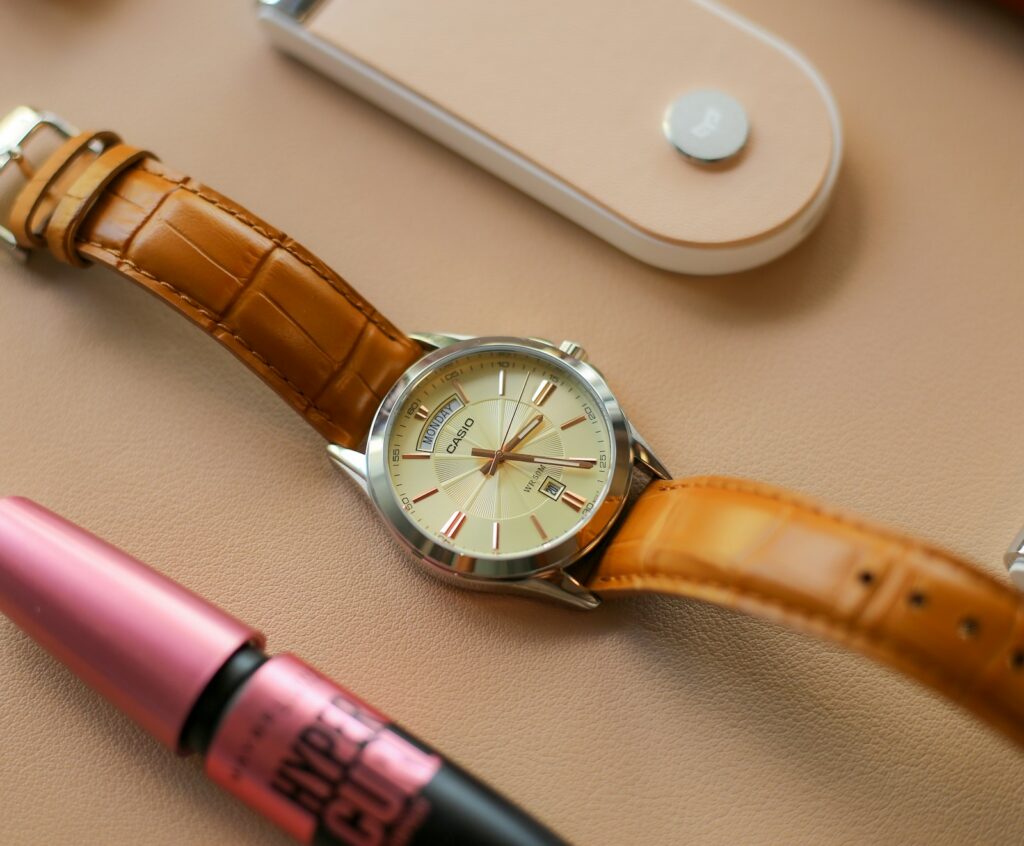
Honest sourcing note: “Alligator” and “crocodile” are different species — true alligator is American (Alligator mississippiensis); most Indonesian/Asian straps are saltwater crocodile (Crocodylus porosus), the same luxury tier. We label species accurately and never sell embossed calf as exotic. Genuine crocodilian is CITES-regulated (typically Appendix II, farmed); international orders ship with documentation, and you are responsible for your country’s import rules — this is general information, not legal advice. Prices are indicative ranges (mid-2026); final pricing is by quote. We are an independent authority and sourcing desk and connect you to vetted makers.
Alligator watch strap price is driven by the leather in front of you: real species, grade, cut, and how the strap is actually built. On this page we break down how much an alligator watch strap realistically costs in 2026, from $150 mid-range to $700+ OEM, why some “gator” straps are far cheaper, and how to tell what you are really paying for.
What You Pay For: The Short Answer (2026)
All price ranges below are indicative, last verified June 2026, and vary by maker, region, and specification.
- Good retail alligator strap (aftermarket, machine + hand-finish): ~US$150–250
- Bespoke / custom alligator or porosus crocodile strap: ~US$250–400+ (complex specs and rare colours can run higher)
- Brand OEM alligator (major Swiss/Japanese maisons): typically ~US$400–700+ at boutiques or service centres
- Wholesale alligator / crocodile straps (volume buyers): ~US$80–150 each ex‑works at modest MOQs, rising with grade and handwork
Those are real-world brackets for genuine exotic watch strap cost — not embossed calf, not caiman marketed as “gator”. The rest of this guide unpacks what moves you between those brackets and how to keep the strap you choose alive for years.
Species 101: What “Alligator” and “Crocodile” Really Mean in Pricing
True alligator vs crocodile vs caiman
For pricing, you must separate three very different animals:
- American alligator (Alligator mississippiensis)
- True “alligator” in the legal and trade sense. Farmed primarily in the United States. Belly scales are large, relatively rectangular, with minimal visible pores. Considered a top-tier luxury strap leather.
- Saltwater crocodile (Crocodylus porosus)
- Often called “porosus” in the trade. Farmed across parts of Southeast Asia and Australia. Similar luxury tier to alligator; scale pattern is a little smaller and more tapered, with visible follicle pores. Many high-end “crocodile” straps are porosus.
- Caiman (Caiman crocodilus and related)
- Smaller, bonier reptile from Latin America. Skin has heavy calcium deposits; feels stiffer and cracks more easily. Much cheaper than alligator or porosus and usually used in “budget exotic” straps.
Why strict species labelling matters
On this site, “alligator” always means American alligator (A. mississippiensis).
“Crocodile” will be named as such, and when we refer to saltwater crocodile we say porosus (C. porosus).
We never:
- Call porosus “alligator”. They are different species, even if both are high luxury.
- Call embossed calf “exotic” — it is printed cowhide.
- Hide caiman under vague “gator-style” language.
That honesty directly affects alligator watch strap price. A $60 “alligator style” strap is almost always embossed calf or caiman. Genuine, well-tanned American alligator simply does not exist at that price once you factor in tanning, wastage, and labour.
Species vs price: the practical effect
Indicative 2026 material cost hierarchy, for the same strap spec and finishing:
- Embossed calf: lowest material cost (printed pattern on cowhide).
- Caiman: ~2–4× embossed calf cost, but still the “budget exotic”.
- American alligator: typically more expensive than caiman by a clear margin.
- Porosus crocodile: often slightly higher or comparable to good alligator, especially for clean belly cuts.
So if a seller quotes the same price for “alligator” and “embossed leather”, assume something is off — or ask to see the CITES species code and an unambiguous leather description.
Retail Alligator Strap Pricing (Mid-Market Aftermarket)
This is the bracket most collectors hit first: off-the-shelf straps sized to common lug widths like 18/16, 20/16, 21/18, 22/18.
Typical 2026 retail price range
For genuine American alligator or porosus crocodile at a reputable strap house:
- US$150–250 for standard retail alligator/crocodile strap
This usually gets you:
- Top or high-mid grade belly cut
- Standard lengths (e.g., 115/75 mm or 120/80 mm)
- Standard tapers (e.g., 20/16, 21/18, 22/18)
- Edge paint or basic turned-edge construction
- Calf or rubber lining
If you see “genuine alligator” advertised brand-new at under US$120 retail, start interrogating the details:
- Is it actually caiman?
- Is it recycled offcut, very low grade, or patchwork?
- Is it an extremely thin veneer of exotic over cheap filler?
All of those routes technically use some exotic, but they behave very differently on the wrist, especially around curves and at the hole where stress and cracking concentrate.
What moves you up or down inside $150–250
Within that band, real price shifts come from:
- Scale pattern: larger, cleaner central belly scales cost more than mixed or side/baby cuts.
- Finish: complex dyeing (gradient, patina), high-gloss French polish, and fully turned edges all add labour.
- Lining: anti-allergy calf or high-grade rubber costs more than generic split leather.
- Hardware: a solid, well-finished buckle (or a deployant-compatible geometry) adds a bit to the ticket.
But the main driver at this tier is still the hide grade and cut.
Bespoke & Custom Alligator Strap Prices
If you need a precise taper, unusual lug (odd 19 mm, 21 mm, or integrated), or want to match a dial colour exactly, you’re in bespoke territory.
Typical 2026 bespoke price range
For made-to-order straps in genuine American alligator or porosus, hand-built by a competent independent maker:
- US$250–400+ per strap
Straps can and do go higher with:
- Exotic linings (shell cordovan, rare calf, hypoallergenic tech linings)
- Complicated padding geometries for deployants
- Coloured edge paint and contrast hand-stitching
- Matching OEM clasp fittings or proprietary lug profiles
Where the extra money goes in bespoke
You are paying for:
- Pattern drafting for your wrist and watch: precise hole placement, strap length, and thickness for your clasp type.
- Hide selection by hand: choosing the exact section of belly or flank that fits your lug width and keeps a pleasing scale progression.
- Full hand assembly: skiving, shaping, stitching, and burnishing are often 2–4 hours of skilled bench work per strap.
Because each strap is its own build, the same hide and lining can cost quite different amounts depending on length (extra-long requires more of the expensive centre belly) and taper.
If you’re planning a project and want a realistic number before committing, you can plan your trip with a WhatsApp-based consult — we’ll help you spec something appropriate and introduce vetted makers; if you proceed with our partner they may pay us a referral fee at no extra cost to you.
Brand OEM Alligator & Crocodile Strap Prices
Original-equipment straps from luxury brands sit in a very different pricing universe.
Typical 2026 OEM price range
For a genuine alligator or high-grade crocodile strap purchased through a brand boutique or authorised service centre:
- US$400–700+ is common
Some brands exceed this, especially:
- For integrated or proprietary end links
- Where the buckle or deployant is included
- For limited edition colours or unusual padding
Why OEM is so much more expensive
The material and construction can be very good, but the premium is mostly:
- Brand overhead: marketing, boutiques, after-sales service, warranty infrastructure.
- Inventory complexity: maintaining lots of references, colours, and integrated fitments.
- Small batch, complex shapes: integrated ends can’t be easily re-used on other models.
From a pure materials and behaviour standpoint, a well-specified independent alligator strap can equal or surpass many OEM straps at a lower price. What you don’t get is the logo and integrated moulding.
Wholesale Alligator & Crocodile Strap Price Ranges
For micro-brands, retailers, and watchmakers buying in volume, per-strap pricing shifts significantly.
Indicative 2026 wholesale ranges (ex‑works)
These are broad ranges for genuine exotic straps, subject to MOQs, grade, and finishing:
- Caiman straps: ~US$30–70 each
- American alligator straps: typically ~US$80–150 each
- Porosus crocodile straps: typically ~US$90–170 each
These assume:
- Reasonable minimum order quantities (e.g., 30–100 pieces per spec)
- Standard lengths and common lug widths
- Consistent, but not ultra-bespoke, finishing
Complex specs (unusual tapers, coloured stitch + edges, multi-layer padding, high-polish glossy finishes) all push the upper edge of these ranges.
As a sourcing desk, we do not tan hides ourselves. We maintain relationships with tanneries and strap workshops, and we curate suppliers that meet consistent quality and species-labelling standards. For a wholesale or OEM-style enquiry, you can plan your trip by WhatsApp or email; no one can pay to change what we publish, and if you proceed with our partner they may pay us a referral fee at no extra cost to you.
What Actually Drives Exotic Watch Strap Cost
Here’s how the main factors stack up:
| Factor | What it is | Effect on price | Effect on behaviour |
|---|---|---|---|
| Species | Alligator vs porosus vs caiman vs calf | Alligator/porosus at top; caiman and calf lower | Alligator/porosus flex and age better; caiman more crack-prone |
| Grade | Skin quality: scars, bites, grain consistency | Higher grade = higher cost per square foot | Cleaner appearance; fewer weak spots at stress points |
| Cut | Belly vs side vs tail/hornback | Belly generally costs more | Belly is more supple; hornback is rigid and dramatic |
| Finish | Matte, semi-matte, glossy, special dyes | Gloss and complex dyeing increase labour | Glossy hides are more sealed; matte may breathe better |
| Lining | Calf, rubber, nubuck, hypoallergenic synthetics | High-spec linings add cost | Impacts sweat resistance and comfort |
| Construction | Machine vs hand-made, edge style, stitching | Fully hand-made = more expensive | Better shaping, longevity and finishing detail |
| Fitment complexity | Integrated ends, curved lugs, deployant geometry | More complex patterns raise price | Better watch fit, but fewer watches share the strap |
Species and grade: the core cost
The jump from mid-tier to high-end is mostly:
- Species: alligator/porosus instead of caiman.
- Grade: large, even belly tiles with minimal scars or bite marks.
High-grade belly for straps means enough clean area to cut straight, symmetrical scale runs for both long and short sides. That limits how much of each hide a strapmaker can use, which in turn raises the cost per usable piece.
Cut: belly vs hornback and how they wear
- Belly cut alligator/porosus: softer, more flexible, classic look; usually the most expensive cut for straps.
- Side/shoulder cuts: smaller scales, sometimes cheaper; can still be excellent for narrower straps.
- Hornback: the raised ridges along the spine; dramatic but inherently stiff and uneven — better for larger wrists and straight-end cases.
Hornback straps are often priced similarly or slightly higher than belly simply because they are more “statement”, but they will not drape like belly. For daily wear on a dress watch, belly is usually the better choice from a behaviour standpoint.
Finish: matte vs glossy vs “patina”
- Matte: more natural, slightly open finish; tends to show scuffs more quickly but can also develop character.
- Gloss: multiple finishing passes, often with heat and glazing; labour-heavy but offers a tight, sealed surface that resists staining.
- Antiqued/patina effects: layered dyes and hand-rubbing; can push the price up due to time and rejection rate.
From a durability viewpoint, good-gloss finishes can protect against moisture and sweat ingress, but any cracking in the topcoat will expose the leather underneath. Matte straps respond more directly to conditioning and will show surface changes more readily.
Lining and construction: what your skin actually contacts
The lining takes most of the sweat, flex, and abrasion, so don’t ignore it:
- Standard calf lining: cost-effective, comfortable; performance depends heavily on tanning and finish.
- Water-resistant / rubberised linings: ideal for hot climates and daily wear; typically higher cost.
- Alcantara/suede-type linings: luxurious feel, but can darken with sweat over time.
Construction details that matter:
- Turned edge vs raw edge: turned edge wraps the exotic over the core and under the lining; it’s more work but gives cleaner, more protected edges.
- Stitch length and tension: too long or too tight can create tear lines; proper saddle stitching is slower but more robust than simple machine passes.
- Core materials: quality fillers (firm yet flexible) preserve the strap shape longer, especially at the buckle bend.
Why Some “Alligator” Straps Are So Cheap
This is the part of the market that generates the most confusion.
Common cost-cutting scenarios
Below ~US$100 retail, many “alligator” or “alligator-style” straps fall into one of these categories:
- Embossed calf: a print plate stamps an alligator-like pattern into cowhide, then it’s dyed to mimic exotic. Perfectly fine if it’s called what it is; not alligator.
- Caiman sold as “gator”: technically exotic, but cheaper, stiffer, and more prone to flaking and cracking at bends.
- Low-grade offcuts: small, inconsistent tiles, scars, brands; used in patchwork constructions or very narrow straps to squeeze usage from each hide.
- Ultra-thin exotic veneer: a thin sheet of exotic laminated onto a cheap base; easier to crack because the working layer is so thin.
These practices allow a low crocodile strap price on paper but do not behave like true, full-weight alligator or porosus.
Red flags to watch for
Signs a strap is unlikely to be high-grade alligator:
- Brand is based far from traditional alligator sources but markets “alligator” at extreme discount without species detail.
- Only photos are heavily retouched, with no close-ups of pores or tile edges.
- No mention of CITES, species name, or origin country anywhere on product or documentation.
- Very rigid feel out of the box with abrupt transition at the fold — often caiman or poorly tanned leather.
Honest strapmakers will tell you clearly: American alligator, porosus, caiman, or embossed calf. If they blur labels, assume pricing is reflecting something cheaper than you think.
CITES & Legality: Why It Affects Price (But Isn’t Legal Advice)
Both American alligator and most commercially traded crocodilian species are regulated under the Convention on International Trade in Endangered Species (CITES), usually under Appendix II. This means:
- The trade is allowed but controlled via permits.
- Most strap leather comes from farmed animals, not wild hunting.
CITES compliance affects cost through:
- Paperwork and inspection fees at export and import.
- Rejection or delays if paperwork is incomplete.
- Limited supply from vetted farms and tanneries.
We are not a law firm and this page is not legal advice. Regulations and enforcement differ by country and can change. Before buying or importing exotic leather goods, verify your own country’s rules or consult a specialist broker.
How to Get the Most Value From an Alligator or Crocodile Strap
Once you understand how price maps to real material and labour differences, “value” means getting that behaviour without paying for marketing noise.
Specification tips by budget
- US$150–250 range: aim for genuine American alligator or porosus belly, simple matte or semi-matte finish, standard taper (20/16 or 21/18), quality calf lining.
- US$250–400 range (bespoke): specify exact length, hole placement, and clasp type; insist on turned edges and hand saddle stitching if possible.
- Above US$400 (non-OEM): only pay the extra if you are getting something structurally different (integrated ends, rare colour, unusual lining) — not just branding.
Care practices that protect your investment
Behaviourally, alligator and porosus like:
- Dry time: rotate straps; don’t wear the same one every single day in hot, humid conditions.
- Mild cleaning: slightly damp cloth to remove sweat and dust; avoid soaking and harsh cleaners.
- Conditioning, sparingly: very light application of a reptile-safe conditioner once or twice a year if the strap looks dry — never soak the strap.
- Buckle changes with care: support the leather near the spring bar and avoid repeated, aggressive bending around the pin.
A well-made, correctly specified alligator strap, worn in rotation and kept reasonably dry, can serve for years. A cheap caiman or embossed strap driven hard in sweat can crack in a season.
Using Alligator Watch Straps as an Independent Sourcing Desk
Alligator Watch Straps is not a tannery and not a mass retailer. Our role is:
- Editorial: explain how materials behave, what species you are looking at, and what real pricing looks like.
- Vetted sourcing: connect collectors, brands, and watchmakers to strapmakers and suppliers with consistent quality and honest labelling.
No one can pay to change what we publish. If you ask us to help you spec and source a strap or a batch for your brand, we may introduce you to a partner; if you proceed with them, they may pay us a referral fee at no extra cost to you.
If you’re planning a custom strap or a wholesale run and want grounded pricing for your exact spec, plan your trip with us. We typically start the discussion by WhatsApp so you can send case photos, lug measurements, and any OEM strap you want us to match or improve on.
FAQs: Alligator Watch Strap Price (2026)
How much does a real alligator watch strap cost?
As of mid-2026, a good quality genuine American alligator strap from an independent maker typically costs about US$150–250 retail. Bespoke builds with custom dimensions and finishing often fall between US$250–400+, while large-brand OEM alligator straps commonly sit around US$400–700+ at boutiques.
Why is there such a wide price range for alligator and crocodile straps?
The range reflects species (alligator vs porosus vs caiman), hide grade, which part of the animal is used (belly vs side vs hornback), the lining, and how much handwork goes into construction. Branding and distribution overhead also increase price, especially for OEM straps, even when material quality is comparable.
Why are some “alligator” straps so cheap online?
Very low-priced “alligator” straps are usually embossed calf, caiman sold under vague wording, or ultra-thin exotic veneers over inexpensive filler. Those materials can be legitimate products, but they do not behave or last like full-weight American alligator or porosus belly, and they should not be labelled as alligator.
Is porosus crocodile more expensive than alligator?
Porosus (Crocodylus porosus) is often priced similarly to or slightly above American alligator for comparable grade and cut, especially for clean belly skins. Both sit at the top of the exotic strap hierarchy. They are different species and should be labelled as such, even if their luxury tier is comparable.
Can I buy wholesale alligator straps for my micro‑brand?
Yes, but expect indicative 2026 ex‑works pricing around US$80–150 per piece for genuine alligator at reasonable MOQs, with porosus often slightly higher. Exact cost depends on grade, finish, lining, and pattern complexity. For tailored ranges and to connect with vetted suppliers, you can plan your trip and start the conversation via WhatsApp.