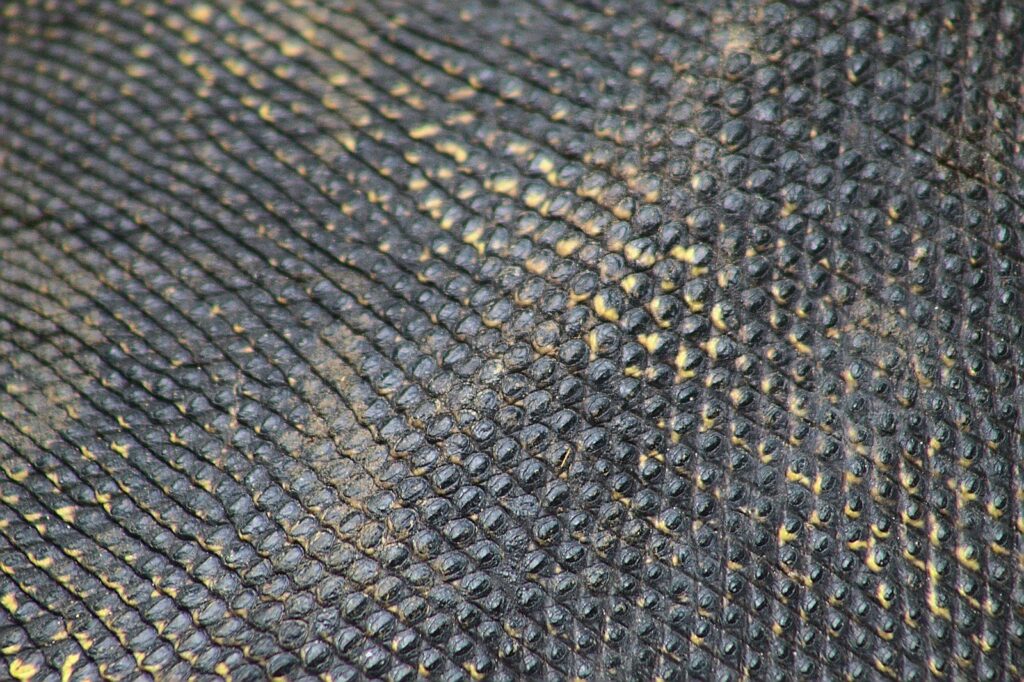
Honest sourcing note: “Alligator” and “crocodile” are different species — true alligator is American (Alligator mississippiensis); most Indonesian/Asian straps are saltwater crocodile (Crocodylus porosus), the same luxury tier. We label species accurately and never sell embossed calf as exotic. Genuine crocodilian is CITES-regulated (typically Appendix II, farmed); international orders ship with documentation, and you are responsible for your country’s import rules — this is general information, not legal advice. Prices are indicative ranges (mid-2026); final pricing is by quote. We are an independent authority and sourcing desk and connect you to vetted makers.
A black alligator watch strap is an exotic-leather watch band made from genuine American alligator (Alligator mississippiensis), tanned and cut for high‑end timepieces. On a dress watch, a well‑cut black alligator strap is the formal default: dark, restrained, and correctly scaled to the lugs, it disappears visually and lets the dial do the talking.
What “Black Alligator” Really Means (Species, Not Marketing)
Most product pages online blur “alligator” and “crocodile” into one word. We don’t.
- True alligator on this page means American alligator – Alligator mississippiensis.
- Saltwater crocodile (often sold in Asia as “alligator”) is typically Crocodylus porosus.
- Embossed calf with a fake scale print is not exotic leather, and we never call it alligator or crocodile.
Both American alligator and saltwater crocodile are CITES Appendix II–listed species. Commercial trade in finished leather goods is allowed when skins are legally farmed or ranched and exported with the correct CITES documentation. That paperwork sits behind the strap you eventually receive; it is not legal advice. Buyers are responsible for verifying what their own country allows to import.
We operate as an independent sourcing and editorial desk, not as a tannery. Our role is to specify precisely what you’re buying and connect you to vetted makers who label species honestly.
Why Black Alligator Is the Formal Default
Black isn’t automatically “better” than brown or blue. It is simply the most conservative, least controversial choice in formal settings.
Visual hierarchy: dial first, strap second
On a black‑dial dress watch, a black alligator strap creates a single dark block on the wrist. Light catches the dial and hands; the strap recedes. That’s correct dress‑watch behavior: the strap frames rather than competes.
Even on lighter dials (silver, cream, white), a black exotic watch band still reads formal:
- Black on white / silver dials – highest contrast, very “tuxedo”; great for thin Calatrava‑style cases.
- Black on grey / anthracite dials – modern and restrained; works well on integrated and minimalist pieces.
- Black on colored dials – tames bolder hues (green, burgundy) and keeps the watch from feeling casual.
Where black alligator makes sense
Use a black alligator or black crocodile watch strap when the context is:
- Business formal – suiting, boardroom, conservative offices.
- Evening wear – black tie, weddings, orchestral performances.
- Collecting “correct” configurations – restoring pieces that originally shipped on black exotic straps.
If your wardrobe is mostly dark tailoring and your collection leans dressy, a single well‑made black alligator strap will see more wrist time than any other color.
Matte vs Glossy Black Alligator: How They Actually Wear
Finish changes how the same hide behaves on the wrist and under light. For black, the matte vs glossy choice is mostly about how formal you want to be and how much you tolerate visible wear.
Matte black alligator strap
A matte black alligator strap is lightly finished so the grain and pore structure are still perceptible.
How it looks
- Subdued reflection: light diffuses across the scales instead of bouncing off.
- Soft texture: more “leather” than “lacquer”; the natural pattern is easy to see.
- Versatile formality: passes in a boardroom but doesn’t look out of place with a knit polo.
How it wears
- Patina over time: edges burnish, high points gain a soft sheen, low points stay matte.
- Scratches blend better: surface marks are less obvious than on high‑gloss.
- Less squeak, more flex: the finish film is thinner, so break‑in is quicker.
For daily office wear or collectors who like a strap to age with the watch, the matte black alligator strap is usually the right answer.
Glossy black alligator strap
Glossy (sometimes called “polish” or “patent‑style”) black alligator uses heavier finishing and ironing to increase shine.
How it looks
- High reflectivity: under evening light, the strap mirrors its surroundings.
- Sharper scale edges visually: gloss exaggerates the geometry of rectangular flank scales.
- Maximum formality: pairs naturally with polished cases and cufflinks.
How it wears
- Shows wear sooner: fine lines, buckle marks, and edge bumps are more visible.
- Needs more careful care: avoid dry abrasion and aggressive brushing on the finish.
- Stiffer out of the box: break‑in takes longer, especially on heavy padding.
For a pure dress piece that only comes out for dinners and ceremonies, a glossy black alligator strap is still the classical choice.
Quick comparison: matte vs glossy black alligator
| Attribute | Matte Black Alligator | Glossy Black Alligator |
|---|---|---|
| Formality | Formal, but can dress down | Very formal / evening‑leaning |
| Scratch visibility | Lower – marks blend in | Higher – marks catch light |
| Break‑in time | Shorter | Longer |
| Best with case finishes | Brushed or mixed finishes | Fully polished cases |
| Daily wear suitability | High | Medium (better as rotation piece) |
If you are unsure, start with matte. You can always order a glossy black exotic watch band later as a second, more formal option.
Alligator vs Crocodile in Black: What Changes on the Wrist
Black compresses color differences. What remains visible is pattern and scale layout.
American alligator (A. mississippiensis)
- Scale geometry: flank cuts give rectangular, fairly even tiles; bellies offer larger, more open rectangles with minimal webbing.
- Surface feel: marginally softer and more pliable at equal tannage than porosus.
- Common usage: Swiss and German high‑end dress pieces, often described simply as “alligator” in manuals.
Saltwater crocodile (C. porosus)
Many “black alligator” straps made in Indonesia and other Asian workshops are actually porosus crocodile. It sits in the same luxury tier as alligator, but it is a different species and must be labelled as such.
- Scale geometry: more tapered and elongated; some natural “pips” (small hair‑follicle pores) remain visible.
- Surface feel: slightly firmer at equal thickness; excellent shape retention.
- Common usage: Asian‑made luxury straps; frequently mis‑tagged online as “alligator”.
For a black crocodile watch strap, porosus is the premium option. In black, the visual difference compared to alligator is small; the real distinction is ethical labelling and how the hide behaves during skiving and edge finishing.
Belly vs hornback (and why hornback is rarely formal)
For black, most buyers want a smooth, dress‑capable strap. That points to:
- Belly / flank cut: flatter scales, easy to wear with cuffs; traditional for dress watch straps in both species.
- Hornback: raised, bony ridges from the spine. Visually aggressive, great for sports watches and big cases, but usually too rugged for a tuxedo.
Our sourcing desk can arrange both. For a conservative dress build, ask for black alligator or black porosus belly/flank with medium or small scales.
Stitching Options: How Much Contrast Is Still Formal?
Stitch color is the second‑strongest visual signal after the strap itself. On a black exotic strap, you can go from very discreet to quite sporty just by changing thread.
Conservative stitching for a formal strap
- Black on black: the default. Visually quiet, especially on matte. Best if the strap must “disappear.”
- Dark grey / charcoal: slightly visible seam without drawing the eye. Pairs nicely with rhodium indices.
- Very dark blue (“midnight”): reads as black at a glance but reveals depth under certain light; a collector favorite for white‑metal cases.
These options keep the strap in formal territory even on sport‑casual watches.
Balanced contrast (office‑friendly, slightly relaxed)
- Medium grey: visible but not loud; echoes steel bracelets and brushed cases.
- Warm off‑white / light beige: a nod to vintage; works well with gilt or cream dials.
On a matte black alligator strap, medium contrast stitching adds character without fully tipping into casual.
High‑contrast stitching (deliberately casual)
- Pure white: very visible, especially on glossy; often seen on pilot or racing styles.
- Colored (red, blue, orange): explicitly sporty. Best on larger tool watches rather than formal dress pieces.
If your goal is a true formal default strap, stay at or below medium contrast.
Which Watches Suit a Black Alligator or Crocodile Strap?
Black exotic straps are less about brand and more about case/dial proportions. Some combinations work almost automatically.
Dress and dress‑adjacent watches
Ideal candidates:
- Thin, time‑only cases – 34–41 mm, under ~11 mm thick.
- Simple dials – two or three hands, maybe a date; minimal printing.
- Polished or mixed‑finish cases in steel, white gold, or platinum.
A matte black alligator strap will make these pieces office‑ready. A glossy version pushes them into evening territory.
Modern sports watches that still work on black alligator
Some sports or everyday watches accept a black exotic strap surprisingly well:
- Thin diver / neo‑vintage sports cases – if lug‑to‑lug is moderate and bezel isn’t oversized.
- Chronographs with clean dials – black or silver registers, minimal color.
- Integrated‑look designs with leather options from the manufacturer.
Here, choose:
- Matte black alligator or porosus to keep things from looking overdressed.
- Stitching in grey or matched dial color for a cohesive, intentional feel.
Cases where black alligator might not be ideal
You may want to avoid a black exotic strap for:
- Very thick tool watches – 44–48 mm, >14 mm thick; the mismatch between case bulk and formal strap can look forced.
- Bright, playful dials – pastel colors, loud racing graphics often pair better with calf or rubber.
- Ultra‑casual daily beaters – where a fabric or rubber strap is more practical and more honest about the watch’s role.
If you are unsure, share clear case and wrist photos; we can give specific feedback through WhatsApp or email via plan your trip for your strap “rotation” and match.
Real Specs: Widths, Tapers, Padding, and Lining
We approach black alligator straps the way a case designer approaches lugs: in millimetres and curves, not adjectives.
Lug widths and tapers
Common lug widths and recommended tapers for a formal‑leaning black alligator strap:
- 18 mm
- Taper to 16 mm or 14 mm. Perfect for smaller dress watches.
- 19 mm
- Taper to 16 mm. Keeps the visual line slim without over‑tapering.
- 20 mm
- Taper to 16 mm or 18 mm depending on how dressy you want it.
- 21 mm
- Taper to 18 mm. Common on modern luxury sports‑dress hybrids.
- 22 mm
- Taper to 18 mm or stay straight at 22 mm for larger sport cases.
For the cleanest formal look, a 4 mm taper (e.g., 20→16) on black alligator is the sweet spot.
Length and fit
Standard lengths often quoted in exotic straps:
- Short: ~105 / 65 mm
- Regular: ~115 / 75 mm
- Long: ~125 / 85 mm
Your wrist size, watch case, and buckle style all affect the ideal length. A formal strap should position the buckle or deployant roughly centered on the underside of the wrist, not off to the side.
Padding profile
Black alligator is unforgiving of clumsy padding; the eye catches thickness immediately.
- Unpadded / flat (2.0–2.5 mm) – best for ultra‑thin cases and formal pieces.
- Lightly padded (≈3.0–3.5 mm at lug, tapering towards tip) – our usual recommendation for modern dress and sport‑dress watches.
- Heavy padding (4.0+ mm) – reserved for big sports cases or hornback builds; rarely ideal for a true formal default.
Lining: where comfort and longevity are decided
The surface you don’t see determines how long a black exotic strap lasts.
Common linings for our network’s builds:
- Calf leather lining – traditional, comfortable, can be color‑matched or neutral.
- Hydrophobic / treated calf or goat – better sweat resistance for humid climates and daily wear.
- Hypoallergenic synthetics – for clients with metal or leather sensitivities; function over romance, but very practical.
For a formal alligator strap worn regularly, a breathable, treated calf lining in beige or tan is usually the smartest option: it hides discoloration and handles moisture better than light‑colored exotics.
Grading and Cut: How Quality Shows Up on a Black Strap
Black hides less color variation but magnifies mistakes in cutting and finishing.
Grading basics for alligator and porosus
Tanneries grade crust and finished skins primarily by:
- Scar and defect count
- Scale regularity
- Overall usable area
For watch straps, you want:
- Central, symmetrical scale layouts – belly or mid‑flank, not the edge of the hide.
- Minimal scars in the strap area – tiny natural imperfections are fine; large healed scars should be avoided on the visible side.
Top grades typically end up as case‑matching OEM straps for large brands or high‑end leather goods. Our job as a sourcing desk is to identify workshops that consistently buy appropriate grades and cut for symmetry, especially on black where misalignment stands out.
Cut and alignment failures to avoid
On a black alligator strap, quality issues often appear as:
- Off‑center scale rows – the centerline of the scales doesn’t match the strap’s centerline.
- Mismatched pair – long and short pieces obviously cut from different areas, with different scale sizes.
- Uneven edge paint – waves or over‑burnished sections where the black edge catches light irregularly.
These are visible in photos before you buy. A reputable maker (and any order routed through us) should provide clear, straight‑on shots of both strap halves before shipping for custom work.
CITES, Legality, and Shipping: What You Need to Know
Both American alligator (A. mississippiensis) and saltwater crocodile (C. porosus) are regulated under CITES Appendix II. That means:
- Commercial trade is allowed in skins and finished goods from approved sources.
- Raw skins cross borders with CITES export/import permits and quotas managed at the government level.
- Finished consumer products (like watch straps) may or may not require visible permits at import, depending on your country’s rules and thresholds.
We are not a law firm. We work only with suppliers who represent that their hides are sourced legally from CITES‑compliant channels. Import rules on the buyer’s side remain the buyer’s responsibility; regulations can and do change.
If you want help understanding the practical side (for example, which routes our existing customers have successfully used for similar orders), we can share experience—but not legal advice—via plan your trip and coordinate over WhatsApp.
Indicative Pricing, Lead Times, and MOQs (Mid‑2026)
We don’t publish fixed price lists because exotic pricing moves with hide availability, tannery costs, and order volume. The ranges below are indicative only, last verified June 2026, for typical made‑to‑order work through vetted makers in our network.
Single custom black alligator or crocodile strap
For one‑off orders using genuine alligator (A. mississippiensis) or porosus crocodile:
- Indicative retail range: roughly US$180–US$450 per strap depending on:
- Species (porosus often prices above alligator)
- Grade and cut (belly vs flank, scale selection)
- Complexity (fully custom pattern, curved ends, proprietary quick‑release, etc.)
- Typical lead time: about 3–8 weeks from specification sign‑off to ready‑to‑ship, assuming hides are in stock.
Wholesale / OEM‑style batches
For brands, microbrands, or retailers ordering black exotic watch bands in volume:
- Indicative MOQs: often 30–100 straps per spec (width/length/finish) for economic pricing.
- Indicative unit range: roughly US$80–US$220 per strap ex‑works for standard configurations, depending on species, grade, and order size.
- Lead time for batches: generally 6–16 weeks including sample approval and production.
We are transparent that we act as an independent sourcing and advisory desk. We research and curate strap makers; no one can pay to change what we publish. If you proceed with our partner they may pay us a referral fee at no extra cost to you.
For a tailored quote, technical drawings, or to align on MOQs and QC, use plan your trip and we can continue details over WhatsApp if that’s easier for you.
Making a Black Alligator Strap Last: Care That Matches the Material
Black hides stains better than lighter colors, but the underlying leather is the same. The goal is to manage moisture and abrasion so the strap dries between wears and the finish isn’t sanded off by clothing or cuffs.
Daily use and rotation
- Rotate if possible: don’t wear the same black strap every day; let it rest at least 24 hours between uses.
- Unbuckle after wear: flatten the strap gently so sweat can evaporate from the lining.
- Avoid soaking: brief rain exposure is fine; submersion or repeated heavy sweat will shorten life.
Cleaning a black alligator or crocodile strap
- Surface wipe: use a slightly damp, lint‑free cloth on the top side; no soaking, especially on glossy finishes.
- Lining clean: wipe with a barely damp cloth and allow to dry fully away from direct heat or sun.
- Conditioning: if needed, an extremely small amount of a neutral, reptile‑safe conditioner on matte finishes only; avoid oily products and avoid the edges.
For glossy black, focus on keeping dry and dust‑free. Over‑conditioning can dull the shine and soften the finish film prematurely.
Storage
- Moderate environment: store at typical indoor humidity, away from radiators or direct strong sunlight.
- No crushing: avoid storing under heavy objects or in tight watch rolls that sharply crease the strap.
- Keep away from solvents: fragrances, insect sprays, and cleaning agents can damage the finish.
Ordering a Black Alligator or Crocodile Strap Through Us
Our role is to help you specify and source the right strap, not to push whatever is in stock.
A typical custom order path:
- Define the watch and use‑case – brand, model, lug width, wrist size, and how formal you want the strap to be.
- Choose material and finish – American alligator vs porosus crocodile, matte vs glossy, belly vs flank.
- Lock specs – width/taper, thickness, length, stitch color, lining type, buckle or deployant compatibility.
- Quote and lead time – we obtain real quotes from vetted makers and share options.
- Photo approval – for fully custom work, you can approve hide selection or finished strap photos before shipment when the workshop offers that step.
To start the process or discuss wholesale runs, use plan your trip. If you prefer to fine‑tune details by voice or quick photos, we can continue the specification over WhatsApp as well.
FAQs: Black Alligator & Black Crocodile Straps
Is a black alligator watch strap more formal than brown?
Yes. In most dress codes, black alligator or crocodile is considered more formal than brown. Brown can still be dressy, especially in darker shades, but black aligns more naturally with business formal and evening wear, particularly on white‑metal cases and black or silver dials.
Should I choose matte or glossy black for a first exotic strap?
For a first and frequently worn strap, matte black alligator is usually the safer, more versatile choice. It handles daily wear better, hides small marks more effectively, and works with both business and smart‑casual outfits. Glossy black is best kept for a dedicated dress watch that you wear less often and mainly in formal settings.
What stitching color is best on a formal black exotic watch band?
For a formal strap, choose black on black, very dark grey, or another very dark tone that stays close to the strap color. These options keep the strap visually quiet and let the watch dial stand out. Medium grey or warm off‑white stitching can still look refined but starts to move the strap toward a more relaxed, semi‑casual feel.
How can I be sure a “black alligator” strap isn’t just embossed calf?
Look closely at scale variation and pores. Genuine alligator or crocodile shows irregular scale sizes, natural transitions, and tiny pore marks in some tiles, especially in porosus. Embossed calf patterns repeat almost mechanically and lack real depth at the edges of the scales. Reputable sellers also label the exact species (e.g., Alligator mississippiensis or Crocodylus porosus) and do not hide behind vague “alligator pattern” wording.
Does CITES affect buying a black alligator or crocodile strap online?
Yes, potentially. Alligator and saltwater crocodile are CITES Appendix II species, so international trade is regulated. Most finished straps sold through reputable channels originate from legally farmed or ranched hides with CITES documentation at the wholesale/export level. However, your country may still have specific import rules or enforcement practices. We work only with suppliers who stay within the legal framework, but you should verify your own country’s regulations before ordering across borders.