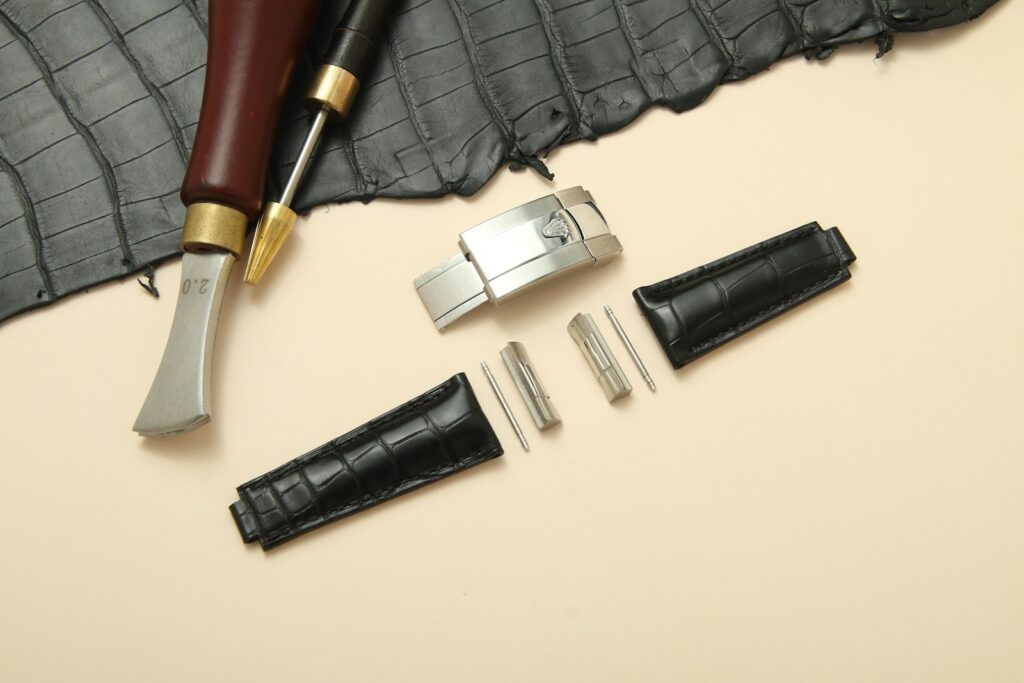
Honest sourcing note: “Alligator” and “crocodile” are different species — true alligator is American (Alligator mississippiensis); most Indonesian/Asian straps are saltwater crocodile (Crocodylus porosus), the same luxury tier. We label species accurately and never sell embossed calf as exotic. Genuine crocodilian is CITES-regulated (typically Appendix II, farmed); international orders ship with documentation, and you are responsible for your country’s import rules — this is general information, not legal advice. Prices are indicative ranges (mid-2026); final pricing is by quote. We are an independent authority and sourcing desk and connect you to vetted makers.
An alligator strap for Rolex is an aftermarket, non-Rolex leather strap cut from American alligator and sized precisely to your Rolex lug width, case, and clasp. On this page I’ll walk through which Rolex models wear an alligator or crocodile strap well, how to size them correctly, and what to know about species, legality, and honest labelling before you order.
Rolex + Alligator: What We Mean (and What We Don’t)
I’ll be very clear upfront:
– We are talking about **aftermarket straps**, not Rolex OEM parts and not counterfeit “Rolex” straps.
– A **Rolex alligator watch strap** means a strap that fits a Rolex case, made by an independent strap maker, from genuine exotic leather.
– We never add logos, crowns, or trademarks. Your original bracelet/strap remains your Rolex part; our specialty is the strap that sits between the lugs.
A few ground rules we follow:
– **No fake exotics** – we never call embossed calf “alligator” or “crocodile.”
– **Correct species names** every time:
– **American alligator** = *Alligator mississippiensis* (mostly U.S. origin).
– **Saltwater crocodile** = *Crocodylus porosus* (often Indonesian/Asian origin).
– Many “Asian alligator” straps sold online are actually **porosus crocodile**, not alligator. Porosus is a top-tier exotic, just a **different species**, and it should be labelled that way.
AlligatorWatchStrap.com is an independent sourcing and editorial desk. We:
– Curate and spec straps with vetted makers.
– Verify species and construction.
– Quote **price ranges** and **leadtimes** (not fixed catalog prices).
– Connect retail and wholesale buyers with the right maker for their brief.
No one can pay to change what we publish; if you proceed with our partner they may pay us a referral fee at no extra cost to you.
Which Rolex Models Suit an Alligator or Crocodile Strap?
Rolex design language is built around bracelets, but many references take an exotic strap very well. Think about **case profile**, **lug width**, and **intended use**.
Dress-Oriented Models (Ideal Candidates)
These are the most natural fit for a crocodile strap Rolex or true alligator:
– **Rolex Datejust (36mm & 41mm)**
– Works especially well on smooth bezels and fluted bezels in precious metal.
– A dark matte alligator or porosus strap turns a Datejust into a classic dress piece.
– Often ordered as an **exotic strap for Rolex Datejust** in 20/16 mm or 21/18 mm depending on case generation.
– **Day-Date (President)**
– Traditionally paired with the President bracelet, but many collectors keep the bracelet in the safe and wear the watch on **high‑grade porosus or alligator** for formal use.
– The heavier gold case benefits from a **medium‑padding strap** for balance.
– **Cellini**
– Many Cellini references come on leather already. Replacing a worn strap with a well-specced alligator or crocodile keeps the dress intent while improving fit and finish.
– Cellini lugs are straight, so standard straight‑end straps fit well.
Sports Models (Viable, With Caveats)
Sports Rolex on exotic straps are more polarizing, but there is a strong enthusiast niche:
– **Submariner / Sea-Dweller / GMT-Master II / Explorer II / Yacht-Master**
– Lug widths: commonly **20 mm**.
– On matte or semi‑matte **alligator or croc**, these become more “sports-chic” than pure dive/tool watches.
– Not for real diving or harsh use; treat the strap like any fine leather.
– **Daytona**
– Rolex already pairs some Daytonas with OEM alligator or oysterflex; an aftermarket exotic makes aesthetic sense.
– Good candidate for **curved‑end** straps for a tighter case fit.
Models We Rarely Recommend for Exotic Straps
– **Deepsea** – case thickness and lug geometry make most alligator straps look visually overwhelmed.
– **Very small vintage Rolex (30–32 mm)** – lug widths and proportions can be tricky; we handle these as one‑off custom specs only.
Rolex Lug Widths: Core Sizes for Alligator & Croc Straps
The single most important measurement for any alligator strap for Rolex is **lug width**: the internal width between the lugs, in millimeters.
Common Rolex lug widths (typical, but always measure your specific reference):
- 19 mm
- Many vintage 34–36 mm Datejust and Oyster Perpetual references.
- 20 mm
- Classic sports (Submariner, GMT-Master II, Explorer II, many Daytona, some Datejust).
- 21 mm
- Modern Datejust 41, some newer references with broader lugs.
- 22 mm
- Less common in Rolex; if present, usually on larger, modern cases.
We strongly advise **measuring with a caliper** rather than relying only on online lists, especially for:
– Transition years and “in‑between” references.
– After‑polishing cases where lug geometry may have changed.
Standard Taperness for Rolex-Fit Exotic Straps
Once the lug width is set, you specify **taper** (lug width → buckle/clasp width). Typical tapers we see:
| Rolex Lug Width | Common Strap Taper | Wearer Intent |
|---|---|---|
| 19 mm | 19 → 16 mm or 19 → 14 mm | Vintage feel, light and dressy. |
| 20 mm | 20 → 16 mm or 20 → 18 mm | Balanced modern (16) or sportier (18). |
| 21 mm | 21 → 18 mm or 21 → 16 mm | Datejust 41: 18 for OEM-like presence, 16 for dress. |
We can cut to fit:
– Your **Rolex OEM buckle** (usually 16 mm or 18 mm).
– A high‑grade **aftermarket tang buckle**.
– A **third-party deployant** sized to your wrist.
Species: True Alligator vs Porosus Crocodile vs Calf
This is the part I insist on: **call each species what it is**.
American Alligator – *Alligator mississippiensis*
– Origin: Primarily U.S. (Louisiana, Florida, etc.), farmed and wild‑harvested under management plans.
– Typical strap patterns:
– **Belly cut** – larger, more rectangular scales, fewer growth marks.
– **Flank/hornback** – smaller, more irregular scales, or raised osteoderms for more aggressive texture.
– Feel: Supple with a “soft” hand when tanned well.
– CITES status: **Appendix II**, trade in farmed skins is common but regulated by permits and tagging.
Saltwater Crocodile – *Crocodylus porosus*
– Origin: Indonesia, Papua New Guinea, Australia, and other Indo‑Pacific regions.
– Many “Indonesian alligator” straps you see online are actually **porosus crocodile**.
– Luxury tier: Equivalent to or above alligator in many fashion houses, but we still label it honestly as **crocodile**, not alligator.
– Pattern:
– Belly scales often a bit smaller and more regular.
– Very fine, high‑end grain when finished.
What We Won’t Do
– We **never** call embossed calf “alligator” or “crocodile”. If it’s calf with a print, it’s sold as calf.
– We do not blur **alligators** and **crocodiles** into “gator” or “croc” on invoices; species is spelled out.
If you request “alligator” we source *Alligator mississippiensis*. If you request porosus, you get *Crocodylus porosus*. If the market or CITES logistics suggest an alternative (e.g., Nile crocodile), we say so explicitly and get your written approval before cutting.
CITES & Legality: What You Need to Know
Alligator and most crocodiles used for high-end straps are covered by **CITES (Convention on International Trade in Endangered Species)**, typically **Appendix II**.
What this means in practice:
– **Farmed, tag-traceable skins** – Legal trade is built around controlled farms and tagging systems.
– **Export/import paperwork** – Skins and sometimes finished straps may require CITES permits for international shipments.
What we do:
– Work only with partners who buy from **licensed tanneries** and can show **CITES tags** for their raw skins.
– For cross‑border orders (especially wholesale), we help you understand broadly what paperwork is involved.
What we do **not** do:
– We do not provide legal advice. Regulations differ by country and can change.
– We will tell you plainly: **you must verify import rules in your own country** (or use a broker who will).
If you want to discuss an international order, reach out early so we can structure the build and shipping in a compliant way. You can plan your trip to a new strap with us via email or WhatsApp; we typically answer sourcing and CITES‑related questions within one business day.
Construction Details That Matter on a Rolex Exotic Strap
A crocodile strap Rolex owners will actually wear needs to do more than look good. Construction choices affect longevity and comfort.
Cut and Grain Orientation
– **Belly cut** (alligator or porosus):
– Clean, even scales.
– Best choice for a formal Datejust or Day‑Date.
– **Flank/hornback**:
– Visually stronger, more texture.
– Suits sports Rolex (Sub, GMT, Explorer II) or those who want a more assertive strap.
We normally match:
– **Dress Rolex** → belly cut, subtle sheen or matte.
– **Sports Rolex** → flank/hornback or matte belly with more character.
Padding and Profile
– Thin dress: ~2.0–2.5 mm at the lug, tapering to ~1.8–2.0 mm.
– Medium: ~3.0–3.5 mm at the lug (common for Datejust 36/41).
– Sport: ~4.0 mm at the lug for heavier cases (Sub, GMT, Daytona).
Rolex lugs are relatively short, so **oversized padding** can make the watch sit awkwardly high. We tune thickness to:
– Your watch reference.
– Your wrist circumference.
– Your intended use (desk-only vs occasional rain, etc.).
Linings: What Sits Against Your Skin
We generally recommend:
– **Calf or goat lining**, vegetable- or chrome‑tanned for sweat resistance.
– Optionally **rubber‑backed** lining for very humid climates, especially on sports models.
We avoid using exotic lining against the skin on Rolex straps; it adds cost with no functional benefit and can wear prematurely.
Stitching & Edge Finishing
– Stitch: hand‑sewn saddle stitch or precise machine stitch, depending on the maker and budget.
– Thread: poly or linen, chosen for color and wear conditions.
– Edges:
– Hand‑painted with multiple coats and sanding, or
– Turned edges (alligator folded over lining) for a softer, dressier profile.
For any Rolex, we insist on **precise hole spacing** and **correct hole count**, especially if you’ll use a deployant.
End Links: Straight vs Curved for Rolex Cases
Rolex cases are designed around bracelets with integrated end links. On a leather strap you have two primary options.
Straight-End Straps
– The strap ends are cut straight; there is a small, visible gap between the strap and case.
– Advantages:
– Universally compatible.
– Easier, cheaper to produce.
– Faster turnaround.
– Works well stylistically on vintage pieces and Cellini references.
Curved-End (Semi-Integrated) Straps
– The strap ends are cut with a radius to follow the case curve.
– Tighter visual integration, especially on:
– Modern Datejust 36/41.
– Daytona.
– Sub/GMT.
Caveats:
– Must be model‑specific; the same curve won’t fit every reference.
– Slightly more sensitive to tolerances; not all cases that nominally share a lug width are identical.
– Lead times and pricing are usually higher.
We do not produce or sell metal end links with leather inserts styled to mimic original Rolex parts; we stay on the leather side only.
Impact on Value: Originality vs Wearability
Collectors often ask if fitting an alligator strap for Rolex impacts resale.
– **Your original bracelet or strap and clasp are where most value sits.**
Keep them intact and in your box.
– **Wearing the watch on aftermarket alligator or crocodile does not damage the watch** if fitted correctly (correct lug width, not over‑tightening spring bars).
– **Resale**:
– Serious buyers expect the original bracelet/strap and clasp included.
– A high-quality exotic strap may be considered a bonus for the next owner, but it rarely adds hard value in the way a full OEM set does.
– Cheap or mislabelled straps can make a watch feel “off” and may hurt perceived value.
We frame exotic straps as **wearability and personalization upgrades**, not financial investments. If value retention is critical to you, your rule of thumb should be:
– Keep all OEM parts.
– Enjoy your Rolex on a properly‑built exotic strap day-to-day.
– Refit the original bracelet for sale if the buyer prefers it.
Ordering a Custom Alligator or Crocodile Strap for Your Rolex
Because every wrist and reference is different, we treat Rolex straps largely as **custom or semi‑custom builds**, not off‑the‑shelf commodities.
Information We Need from You
To spec a strap properly, we’ll ask for:
– Watch model/reference (or clear case‑front photos).
– Measured **lug width**.
– Wrist size (tight measurement in mm or inches).
– Your preference for:
– Species: **American alligator** vs **porosus crocodile**.
– Cut: belly vs flank/hornback.
– Finish: matte, semi‑matte, or gloss.
– Color: classic (black, dark brown, navy) or other.
– Taper: e.g., 20 → 16 mm or 21 → 18 mm.
– Stitch: tone‑on‑tone vs contrast.
From there we’ll propose a **spec sheet** and an indicative price/lead time range, and match you to a maker from our vetted network whose work fits your brief.
Indicative Pricing & Lead Times (Last Verified June 2026)
Exact prices depend on species, cut, finish, stitching, padding, and order size, but for guidance:
– **Single custom strap, American alligator**
– Belly cut, hand‑stitched, lined, finished edges.
– Indicative range: **USD ~180–350** per strap.
– Typical build time: **3–6 weeks** from final spec confirmation, excluding any CITES/export processing.
– **Single custom strap, porosus crocodile**
– Often pricier raw material and finishing.
– Indicative range: **USD ~250–450+** per strap.
– Similar 3–6 week production window.
– **Wholesale / small-batch (e.g., 20–100 straps)**
– Lower unit cost, but more complex spec work and logistics.
– Common MOQs: **20–50 pieces per color/spec** with lead times **6–12 weeks**, especially if tanning a custom color or managing bulk CITES documentation.
These are **not offers**, just directional ranges so you can budget. For a firm quote, we need your exact brief. To start that process, you can plan your trip with us—send your reference, wrist size, and a note on WhatsApp if you prefer real‑time back‑and‑forth.
Our Role: Independent Sourcing Desk, Not a Tannery
AlligatorWatchStrap.com does not tan hides and does not pretend to be Rolex or any Maison. Our job is:
– To **audit and curate** strap makers capable of true high‑end work.
– To insist on:
– Correct species identification and documentation.
– Honest grading (no “AAA++++” nonsense).
– Real‑world measurements, not just size tags.
– To guide you through:
– Model fitment.
– Spec trade‑offs (thickness, lining, taper).
– Legal/logistics basics if your order crosses borders.
We work with multiple workshops, not a single supplier. If a request falls outside what we can stand behind—for example, adding protected trademarks to a strap—we say no.
FAQs on Alligator & Crocodile Straps for Rolex
Which Rolex models fit an alligator or crocodile strap?
Most modern and vintage Rolex with standard spring‑bar lugs can take an exotic strap: Datejust (36/41), Day‑Date, Cellini, and sports models such as Submariner, GMT‑Master II, Explorer II, and Daytona. The key is matching the correct lug width and choosing an appropriate thickness and profile for the case.
Does wearing my Rolex on an alligator strap affect its value?
Wearing your Rolex on an aftermarket alligator or crocodile strap does not inherently reduce value as long as you keep the original bracelet or strap and clasp. Serious buyers mainly care that original parts are included and the case and lugs are undamaged. A quality exotic strap is usually seen as a wearable upgrade, not a value driver.
How do I know my strap is real alligator, not embossed calf?
Embossed calf has perfectly repeating patterns and usually no pore structure; true alligator shows natural scale variation and small imperfections. We list the exact species (e.g., Alligator mississippiensis or Crocodylus porosus) on spec sheets and invoices and source only from reputable tanneries via our partners. If a seller won’t specify species, assume it’s not genuine exotic.
What lug sizes are common on Rolex for exotic straps?
The most common lug widths we see for Rolex straps are 19 mm (many vintage 34–36 mm models), 20 mm (Submariner, GMT‑Master II, Explorer II, many Daytona and Datejust), and 21 mm (modern Datejust 41 and some newer references). Always measure with a caliper to confirm before ordering a strap.
Can you ship alligator or crocodile straps internationally?
In many cases, yes, but alligator and most crocodiles are CITES Appendix II species, so international trade may require CITES permits or other documentation. Our partners work with tagged, legally sourced skins and can handle paperwork at the export side where applicable, but you are responsible for ensuring import compliance in your country. For any cross‑border order, contact us first so we can discuss options and timelines.