Honest sourcing note: “Alligator” and “crocodile” are different species — true alligator is American (Alligator mississippiensis); most Indonesian/Asian straps are saltwater crocodile (Crocodylus porosus), the same luxury tier. We label species accurately and never sell embossed calf as exotic. Genuine crocodilian is CITES-regulated (typically Appendix II, farmed); international orders ship with documentation, and you are responsible for your country’s import rules — this is general information, not legal advice. Prices are indicative ranges (mid-2026); final pricing is by quote. We are an independent authority and sourcing desk and connect you to vetted makers.
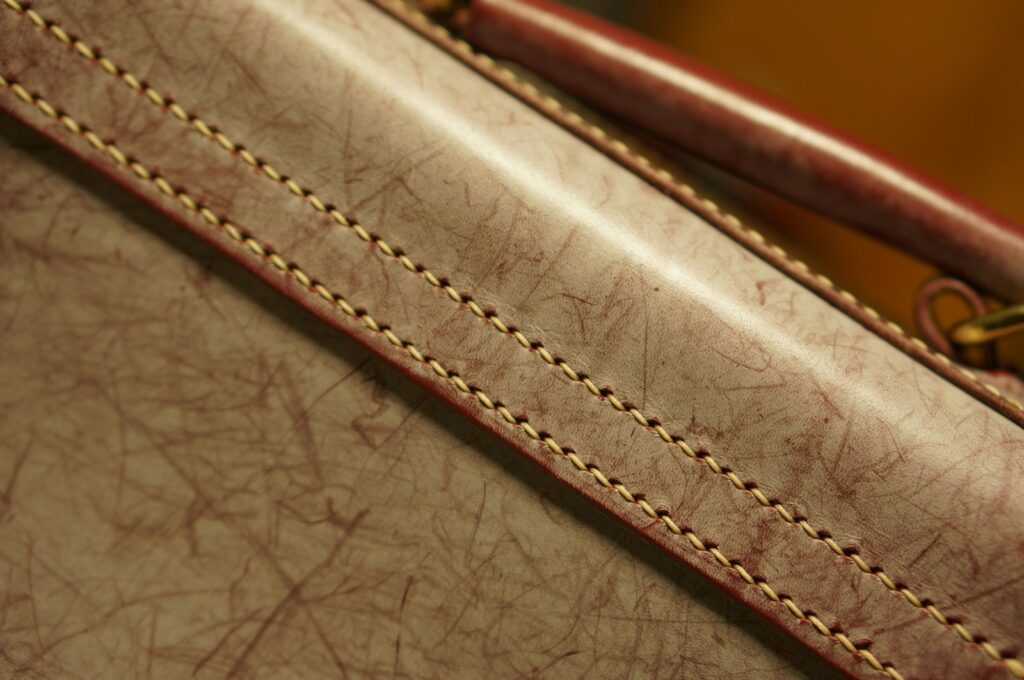
A hand stitched alligator watch strap is a strap made from genuine American alligator leather, sewn by hand using a saddle stitch rather than a machine lockstitch. In high-end strap making, “hand-stitched” refers to a true two-needle saddle stitch that improves durability, serviceability and aesthetics compared with most machine‑sewn straps.
What “Hand-Stitched” Really Means on an Alligator Strap
Most luxury watch owners see “hand stitched alligator watch strap” on a product page and assume it is automatically better. Sometimes that’s true. Sometimes it’s just marketing.
To judge a strap properly you need to understand three things:
1. What stitch is actually used
2. How it interacts with exotic leather like alligator
3. Where hand work genuinely adds value vs a good machine stitch
Saddle stitch vs common machine stitches
A real saddle stitch watch strap is sewn by hand with two needles and one continuous thread passing through each hole from both sides. That construction is fundamentally different from a typical machine lockstitch:
| Stitch type | How it’s made | Failure mode | Where you see it |
|---|---|---|---|
| Saddle stitch (hand) | Two needles, one thread, each hole locked from both sides | If a section breaks, the rest of the row usually stays intact | High-end leatherwork, bespoke straps, restoration |
| Lockstitch (most machines) | Top and bobbin threads interlock inside the leather | If a section fails and unravels, a longer segment can come undone | Mass production straps, fashion belts, bags |
| Chain stitch (some decorative) | Single thread forming loops | Can pull out quickly if broken | Decorative seams, not recommended for strap stress zones |
Saddle stitching is slower and demands more skill. For a 20/16 mm alligator strap with lining and padding, a craftsperson may spend 30–60 minutes just on the stitch line. That time shows in the labor cost—but also in how the strap ages.
Why hand stitching pairs well with alligator
“Alligator” in fine watch straps almost always means American alligator (Alligator mississippiensis), not saltwater crocodile (Crocodylus porosus) or Nile crocodile. The grain structure is different; American alligator has:
– Relatively supple, fibrous structure under the scales
– Subtle, shallow scale edges (especially on belly cuts)
– Good resistance to repeated flex when tanned correctly
A well-executed saddle stitch respects that structure:
– Holes are usually spaced 2.5–3.0 mm apart, punched with pricking irons or chisels, not drilled
– Thread tension is adjusted by hand to avoid cutting into the grain between scales
– Corners (near lugs and buckle) can be double‑stitched or back‑stitched for reinforcement without over-perforating the leather
With a basic machine setup, especially on cheaper straps, stitch tension is often set to work for a wide range of leathers. That can be too aggressive for thinly skived alligator, leading to:
– Micro‑tearing along the stitch line over time
– Slight puckering of the surface, especially on glossy finishes
– Premature failure at the buckle and clasp holes
A good machine operator can avoid these issues, but hand stitching gives the maker more control, one stitch at a time.
Where Hand-Stitched Alligator Straps Actually Matter
A hand vs machine stitch strap debate only matters in certain use cases. For others, a well‑made machine strap is perfectly rational.
1. High wear points: buckle, deployant, and lug ends
On any strap—especially in exotic skins—the stress concentrates at:
– Spring bar holes at the lugs
– The fold at a tang buckle
– The fold under a deployant clasp
This is exactly where saddle stitching shines. Because each stitch is individually locked, localized damage usually doesn’t cause the entire row to unzip. That can be the difference between:
– Re-stitching a section by hand
– Replacing the whole strap
Hand‑stitched straps are also easier to repair. Any competent leatherworker familiar with watch straps can match the original hole spacing and thread type and splice in new thread for a section. Machine lockstitch patterns, especially proprietary ones, can be harder to reproduce neatly.
2. Thicker padded alligator straps
On a 3.5–5.0 mm thick padded strap (typical for sports watches and chronographs), hand stitching allows:
– Cleaner penetration of stacked materials (alligator + padding + liner)
– More control where padding tapers near the lugs and buckle
– Reduced risk of “tunneling” the thread through the padding layer instead of locking through the full thickness
If you like pronounced padding on a Daytona, Royal Oak, or Big Pilot with an alligator upper, paying for proper saddle stitching is usually justified.
3. Dress straps for heavy or valuable watches
Pairing a thin machine‑stitched strap with a dense gold case is asking a lot from the stitch line. For a 40 mm+ heavy case on an alligator strap, a hand‑stitched construction with:
– Full‑length reinforcement (often a synthetic or leather core)
– Rounding or turned edges rather than raw cut and paint only
– Hand‑sewn buckle and lug bar areas
gives you a more predictable aging pattern and better margins of safety.
Hand Stitching Specs That Actually Matter (Not Marketing)
Marketing copy rarely tells you the things that determine longevity. These are the specifications we look at when we evaluate a hand‑stitched alligator watch strap.
Key construction choices
- Species
- American alligator (Alligator mississippiensis) for “alligator” premiums. Porosus or Nile crocodile should always be labelled as crocodile, not alligator.
- Cut
- Belly (flatter, regular scales, best for dress); flank/side (more character, smaller scales); tail (narrower, more elongated scales). Cut affects both aesthetics and how stitches sit.
- Width & taper
- Common sport sizes: 22/18 mm, 21/18 mm, 20/16 mm. Dress: 20/16 mm, 19/16 mm, 18/16 mm. Stronger, more “masculine” look with less taper; more formal with a sharper taper.
- Thickness
- Dress: around 2.0–2.8 mm. Sport / padded: 3.5–5.0 mm at the case, tapering thinner towards the tip.
- Stitch type
- Saddle stitch by hand with two needles; typically 2.5–3.0 mm spacing for alligator. Smaller holes reduce weakening of the leather.
- Thread
- Polyester or linen, thread size usually in the 0.35–0.55 mm range for alligator straps. Thicker for casual / contrast, thinner for dress.
- Edge finish
- Turned edge (upper wrapped around and stitched) or cut edge with multiple coats of edge paint and sanding. Both can be excellent if executed correctly.
- Lining
- Calf (regular or “Zermatt”‑type), rubber, or hypoallergenic synthetic. Lining choice is more important for sweat resistance than the outer leather.
Realistic price ranges for hand-stitched alligator (mid‑2026)
Prices vary with grade, origin, labor cost, and order size. As of June 2026, for genuine American alligator with true hand saddle stitch:
– Retail, off‑the‑shelf strap:
– Approx. US$180–US$420 for standard sizes (e.g., 20/16, 22/18), non‑custom colors
– Semi‑custom (length, taper, thread color, lining options):
– Approx. US$230–US$520
– Full bespoke single strap (you control pattern placement, padding profile, exact thickness):
– Approx. US$280–US$700+ depending on maker, region, and finishing details
– Wholesale / OEM (per strap, larger orders):
– Highly volume‑sensitive; expect roughly a 30–60% discount from comparable retail per‑strap pricing once minimums are met
These are ranges, not quotes. Material grades, origin, and the labor market where the strap is made all move the needle. For up‑to‑date numbers or project‑specific quotes, you can plan your trip with us—email or WhatsApp both work for sharing specs and reference photos.
Alligator vs Crocodile: Labelling and CITES Reality
Hand stitching is only half the story; the base material must be correctly identified and legally sourced.
American alligator is not “just crocodile”
From a collector’s standpoint, “alligator” has come to mean:
– American alligator (Alligator mississippiensis)
– Farmed under regulated programs in the U.S. Southeast
– Exported under CITES Appendix II controls
Porosus (Crocodylus porosus) and other crocodilians are excellent leathers in their own right, but:
– The scale shapes differ (more rectangular / defined in many crocodiles)
– The fiber density and stiffness differ
– Market perception and resale expectations differ
Serious strap buyers expect accurate species labelling. “Genuine alligator” should not be used as a catch‑all term for any crocodilian.
CITES and importing alligator straps
This is not legal advice, but there are a few practical CITES facts to understand:
– American alligator is listed under CITES Appendix II, meaning international trade is controlled but allowed with proper documentation.
– Finished products like watch straps typically require CITES export permits from the country of origin; import rules vary by destination country.
– Some countries also have domestic regulations (for example, EUTR‑related documentation in Europe or state‑level rules in the U.S.) that can affect retail or resale.
– Vintage straps without paperwork can be problematic at some borders, even if the species is currently farmed and legal.
If you intend to ship custom or wholesale quantities of hand‑stitched alligator straps across borders, work with suppliers who can provide:
– Species identification (scientific name)
– Origin (country)
– CITES permit numbers where applicable
We maintain a vetted sourcing desk for exotic‑leather straps and can help you understand realistic lead times and documentation requirements. Use plan your trip to send us your target markets and quantities; WhatsApp is useful for quick clarifications and document screenshots.
Specs: Sizing and Tapers for Hand-Stitched Alligator Straps
A well‑built hand‑stitched strap is wasted if the proportions are off. The main variables are lug width, buckle width, taper, and length.
Common widths and tapers
| Watch type | Typical lug / buckle (mm) | Usual taper | Comments |
|---|---|---|---|
| Dress watch (36–40 mm) | 18/16, 19/16, 20/16 | 2–4 mm taper | Hand stitching usually finer; match thread to dial or case color for subtlety. |
| Steel sports watch | 20/18, 21/18, 22/18 | 2–4 mm taper | Moderate padding; contrast stitching works well for a casual look. |
| Chronograph / pilot | 22/20, 22/18, 24/20 | 2–4 mm taper | Thicker padding near lugs; stronger thread size supports visual weight. |
| OEM-clasp specific | Brand‑dependent | Varies | Custom straps often need exact measurements for OEM deployants. |
On custom orders, you can specify:
– Exact lug and buckle sizes
– Taper profile (e.g., 22 → 20 → 18 mm over the strap length for special clasps)
– Thickness at lugs and thickness at the last hole
– Hole spacing (often 6–8 mm center‑to‑center)
A good hand‑stitching craftsperson can accommodate complex tapers and thickness transitions that cheaper machine‑made straps avoid.
Length and wrist sizing
Standard lengths (approximate):
– Regular: 115/75 mm
– Short: 105/70 mm
– Long: 125/80 mm
If your wrist is under 6.0″ (15.2 cm) or above 7.5″ (19.0 cm), consider specifying a custom length. A hand‑stitched strap tailored to your wrist will sit better, especially around deployant clasps where the fold and buckle position depend heavily on length distribution.
How to Judge a Hand-Stitched Alligator Strap in Person
You don’t need a workshop to spot quality. A 60‑second inspection tells you most of what you need.
Checklist for the stitch line
– Consistent spacing: Holes should be evenly spaced, with stitches forming a regular diagonal pattern.
– Minimal surface tearing: Slight compression around each hole is normal; fuzzy edges or visible tearing of the alligator grain are red flags.
– Corner transitions: At lug corners and keepers, the stitch path should be smooth—no awkward jumps or bunching.
– Back side neatness: Flip the strap over; good saddle stitching looks as clean on the liner as on the alligator side.
Edge and lining inspection
– Edge paint: Multiple thin coats with sanding in between give a smooth, rounded edge rather than a heavy, brittle “lip.”
– Turned edges: Where the alligator wraps around to meet the lining, the join should be flat and evenly bonded, not lumpy.
– Lining attachment: Press lightly; if the lining lifts or bubbles away, the strap will likely fail prematurely in sweaty use.
Brand fitment and hole placement
If you plan to mount the strap on an OEM deployant or a very specific case:
– Spring bar hole distance from the strap tip must match the original strap or case spec
– Thickness at the buckle end should match the clasp’s tolerance; hand‑stitched can be tuned mm by mm
– For integrated or semi‑integrated lugs, pattern shape is critical; hand-cut and hand‑stitched is usually the only route
This is exactly where custom work, guided by measurements and photos, earns its keep.
Custom and Wholesale: When to Go Hand-Stitched
For a single personal strap, hand stitching is often a “buy once, cry once” decision. For collections, retailers, or micro‑brands, economics change.
Collectors and single‑strap buyers
Choose a hand‑stitched alligator strap if:
– You’re matching a serious watch (financially or emotionally)
– You want control over padding, taper, and color combinations
– You care about future serviceability (restitch, re‑line) rather than treating the strap as disposable
A high‑quality machine‑stitched strap is fine for rotating pieces or less formal uses, but most collectors eventually gravitate toward at least a few hand‑stitched “anchor” straps in classic colors (e.g., black, dark brown, navy).
Retailers and micro‑brands
In wholesale or OEM contexts, hand stitching makes sense when:
– You’re positioning the watch or strap as genuinely high‑end
– Your customers expect to scrutinize details with a loupe
– You want to offer restitch / refurbishment services as an after‑sales upsell
For entry‑level lines, a well‑executed machine stitch with honest species labelling usually gives better margin. For halo pieces, limited editions, or boutique‑only SKUs, hand‑stitched alligator can be a rational point of differentiation.
If you’re exploring a full run—say 50–300 straps in American alligator with specific lug widths and a house deployant—we can help sanity‑check specs, species, and finishing before you commit to a tannery or workshop. Share your target price band and requirements via plan your trip; WhatsApp is ideal for going back and forth with prototypes and measurement photos.
FAQs
Is a hand stitched alligator watch strap always better than machine stitched?
No. A carefully made machine-stitched strap in good alligator can outperform a poorly executed hand stitch. The advantage of hand stitching appears when you combine proper saddle stitch technique, quality materials, and thoughtful design around stress points like lugs and buckles.
How long does a hand-stitched alligator strap usually last?
With normal desk wear and sensible care, many owners see 2–5 years of use from a hand-stitched alligator strap before cosmetic replacement, sometimes longer if they rotate straps. Heavy sweat, frequent water exposure, and tight buckling shorten that significantly.
Can I re-stitch or repair a hand-stitched alligator strap?
Often yes. Because saddle stitching uses individual locked stitches, a competent leatherworker can open a damaged section and re-stitch it. Success depends on the condition of the underlying leather and lining; if the alligator itself is cracked or delaminating, replacement is the safer route.
Is porosus crocodile the same as alligator in straps?
No. Porosus (Crocodylus porosus) is a different species with its own grain and pricing structure. It should be sold as crocodile, not “alligator.” Both can be excellent strap leathers, but collectors expect accurate species identification and documentation, especially under CITES rules.
How do I order a custom hand-stitched alligator strap that fits my OEM clasp?
You’ll need accurate lug width, buckle or clasp width, preferred taper, strap thickness targets, and wrist size. Photos of the existing strap and clasp (with measurements) are extremely helpful. Share these through our plan your trip page—email or WhatsApp—and we can help you spec a strap that fits your hardware correctly.